Question 4
Show that and have the same image. Compare their orientations and speeds of traversal at matching points. Then give a reparameterization with the opposite orientation.

Show solutionHide solution
Question 4 – Solution
Strategy Relate parameters by matching all three components.
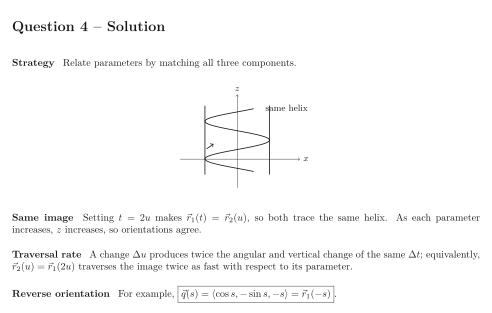
See the diagram in the original worksheet below.
Same image Setting makes , so both trace the same helix. As each parameter increases, increases, so orientations agree.
Traversal rate A change produces twice the angular and vertical change of the same ; equivalently, traverses the image twice as fast with respect to its parameter.
Reverse orientation For example, .