Equations of Lines — Question 10

PDF ↗

Question 10

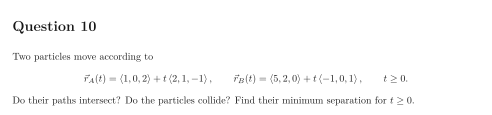
Two particles move according to r→A(t)=⟨1,0,2⟩+t⟨2,1,−1⟩,r→B(t)=⟨5,2,0⟩+t⟨−1,0,1⟩,t≥0.\vec r_A(t)=\left\langle 1,0,2\right\rangle+t\left\langle 2,1,-1\right\rangle,\qquad \vec r_B(t)=\left\langle 5,2,0\right\rangle+t\left\langle-1,0,1\right\rangle,\qquad t\ge 0. Do their paths intersect? Do the particles collide? Find their minimum separation for t≥0t\ge 0.

Original worksheet page 1: question and worked solution for 6-2-010
Show solutionHide solution

Question 10 – Solution

Strategy Path intersection permits different parameters; collision requires the same time. Minimum separation comes from minimizing the squared relative distance.

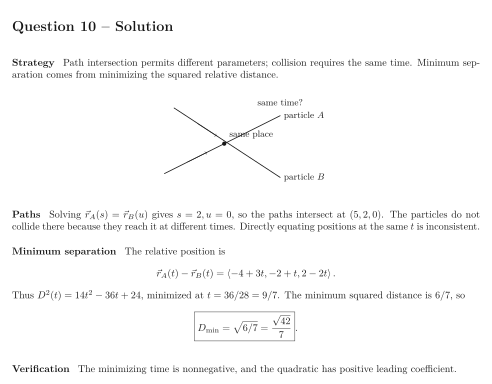
See the diagram in the original worksheet below.

Paths Solving r→A(s)=r→B(u)\vec r_A(s)=\vec r_B(u) gives s=2,u=0s=2,u=0, so the paths intersect at (5,2,0)(5,2,0). The particles do not collide there because they reach it at different times. Directly equating positions at the same tt is inconsistent.

Minimum separation The relative position is r→A(t)−r→B(t)=⟨−4+3t,−2+t,2−2t⟩.\vec r_A(t)-\vec r_B(t)=\left\langle-4+3t,-2+t,2-2t\right\rangle. Thus D2(t)=14t2−36t+24D^2(t)=14t^2-36t+24, minimized at t=36/28=9/7t=36/28=9/7. The minimum squared distance is 6/76/7, so Dmin=6/7=427.\boxed{D_{\min}=\sqrt{6/7}=\frac{\sqrt{42}}7}.

Verification The minimizing time is nonnegative, and the quadratic has positive leading coefficient.
Original worksheet page 2: question and worked solution for 6-2-010

Original worksheet layout. Use Enlarge or open the PDF for a closer view.