Equations of Lines — Question 9

PDF ↗

Question 9

Show that L1:r→=⟨2,−1,3⟩+t⟨4,2,−2⟩andL2:r→=⟨8,2,0⟩+s⟨−2,−1,1⟩L_1:\vec r=\left\langle 2,-1,3\right\rangle+t\left\langle 4,2,-2\right\rangle\quad\text{and}\quad L_2:\vec r=\left\langle 8,2,0\right\rangle+s\left\langle-2,-1,1\right\rangle describe the same geometric line. Find the parameter conversion between tt and ss.

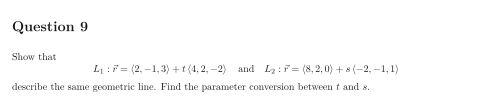
Original worksheet page 1: question and worked solution for 6-2-009
Show solutionHide solution

Question 9 – Solution

Strategy Check parallel directions and show that one base point lies on the other line.

See the diagram in the original worksheet below.

Same point set The second direction is −12⟨4,2,−2⟩-\tfrac 12\left\langle 4,2,-2\right\rangle. Also ⟨8,2,0⟩=⟨2,−1,3⟩+32⟨4,2,−2⟩\left\langle 8,2,0\right\rangle=\left\langle 2,-1,3\right\rangle+\tfrac 32\left\langle 4,2,-2\right\rangle, so the second base point lies on L1L_1. Thus the lines coincide.

Parameter conversion Equating the representations gives r→=r→0+td→=r→0+32d→−s2d→,\vec r=\vec r_0+t\vec d=\vec r_0+\frac 32\vec d-\frac{s}{2}\vec d, so t=32−s2\boxed{t=\frac 32-\frac{s}{2}}, equivalently s=3−2ts=3-2t.

Verification The conversion makes all three coordinates identical.
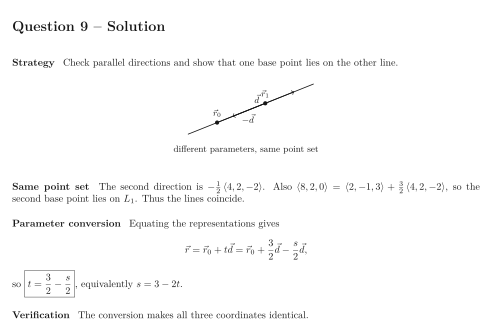
Original worksheet page 2: question and worked solution for 6-2-009

Original worksheet layout. Use Enlarge or open the PDF for a closer view.