Question 2
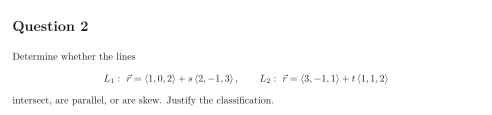
Determine whether the lines intersect, are parallel, or are skew. Justify the classification.
Show solutionHide solution
Question 2 – Solution
Strategy Equate coordinates. An intersection requires one pair satisfying all three equations.
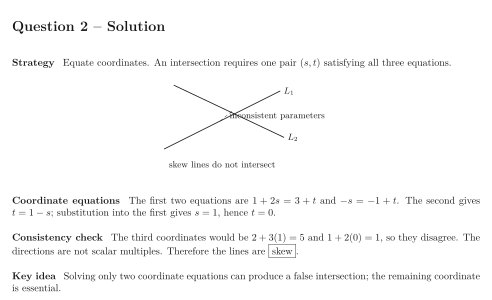
See the diagram in the original worksheet below.
Coordinate equations The first two equations are and . The second gives ; substitution into the first gives , hence .
Consistency check The third coordinates would be and , so they disagree. The directions are not scalar multiples. Therefore the lines are .
Key idea Solving only two coordinate equations can produce a false intersection; the remaining coordinate is essential.