Equations of Lines — Question 3

PDF ↗

Question 3

Find the distance from P=(3,1,−2)P=(3,1,-2) to the line L:r→=⟨1,−1,2⟩+t⟨2,1,−2⟩L:\vec r=\left\langle 1,-1,2\right\rangle+t\left\langle 2,1,-2\right\rangle and find the closest point on LL.

Original worksheet page 1: question and worked solution for 6-2-003
Show solutionHide solution

Question 3 – Solution

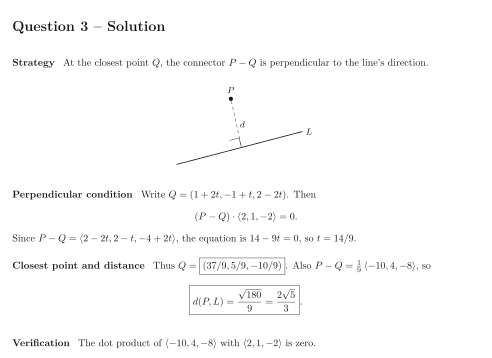
Strategy At the closest point QQ, the connector P−QP-Q is perpendicular to the line’s direction.

See the diagram in the original worksheet below.

Perpendicular condition Write Q=(1+2t,−1+t,2−2t)Q=(1+2t,-1+t,2-2t). Then (P−Q)⋅⟨2,1,−2⟩=0.(P-Q)\cdot\left\langle 2,1,-2\right\rangle=0. Since P−Q=⟨2−2t,2−t,−4+2t⟩P-Q=\left\langle 2-2t,2-t,-4+2t\right\rangle, the equation is 14−9t=014-9t=0, so t=14/9t=14/9.

Closest point and distance Thus Q=(37/9,5/9,−10/9)Q=\boxed{(37/9,5/9,-10/9)}. Also P−Q=19⟨−10,4,−8⟩P-Q=\frac 19\left\langle-10,4,-8\right\rangle, so d(P,L)=1809=253.\boxed{d(P,L)=\frac{\sqrt{180}}9=\frac{2\sqrt 5}{3}}.

Verification The dot product of ⟨−10,4,−8⟩\left\langle-10,4,-8\right\rangle with ⟨2,1,−2⟩\left\langle 2,1,-2\right\rangle is zero.

Original worksheet page 2: question and worked solution for 6-2-003

Original worksheet layout. Use Enlarge or open the PDF for a closer view.