Question 6
Prove that a particle with nonzero velocity is speeding up exactly when , and slowing down exactly when .

Show solutionHide solution
Question 6 – Solution
Strategy Differentiate speed through its square to avoid differentiating a square root prematurely.
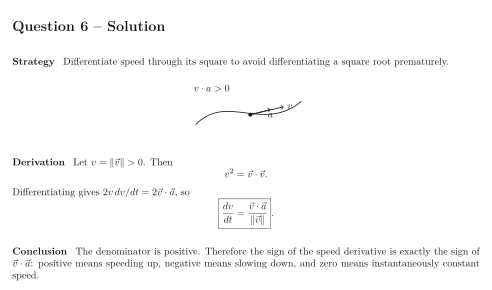
See the diagram in the original worksheet below.
Derivation Let . Then Differentiating gives , so
Conclusion The denominator is positive. Therefore the sign of the speed derivative is exactly the sign of : positive means speeding up, negative means slowing down, and zero means instantaneously constant speed.