Velocity and Acceleration — Question 7

PDF ↗

Question 7

A particle has acceleration a→(t)=⟨2,6t,et⟩\vec a(t)=\left\langle 2,6t,e^t\right\rangle, initial velocity v→(0)=⟨1,−1,0⟩\vec v(0)=\left\langle 1,-1,0\right\rangle, and initial position r→(0)=⟨2,0,3⟩\vec r(0)=\left\langle 2,0,3\right\rangle. Determine v→(t)\vec v(t) and r→(t)\vec r(t).

Original worksheet page 1: question and worked solution for 6-11-007
Show solutionHide solution

Question 7 – Solution

Strategy Integrate twice and use each vector initial condition to determine constants.

See the diagram in the original worksheet below.

Velocity v→(t)=⟨2t+C1,3t2+C2,et+C3⟩.\vec v(t)=\left\langle 2t+C_1,3t^2+C_2,e^t+C_3\right\rangle. Using v→(0)=⟨1,−1,0⟩\vec v(0)=\left\langle 1,-1,0\right\rangle gives v→(t)=⟨2t+1,3t2−1,et−1⟩.\boxed{\vec v(t)=\left\langle 2t+1,3t^2-1,e^t-1\right\rangle}.

Position Integrating again and applying r→(0)=⟨2,0,3⟩\vec r(0)=\left\langle 2,0,3\right\rangle, r→(t)=⟨t2+t+2,t3−t,et−t+2⟩.\boxed{\vec r(t)=\left\langle t^2+t+2,t^3-t,e^t-t+2\right\rangle}.

Verification Differentiating the final position recovers v→\vec v, and differentiating once more recovers the given acceleration.
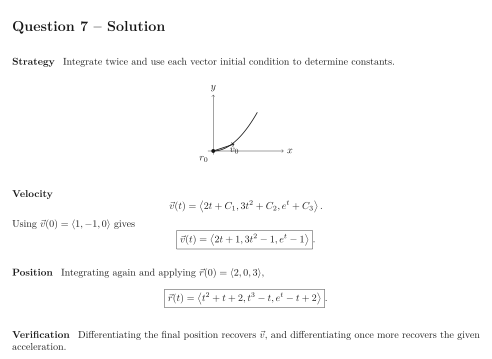
Original worksheet page 2: question and worked solution for 6-11-007

Original worksheet layout. Use Enlarge or open the PDF for a closer view.
