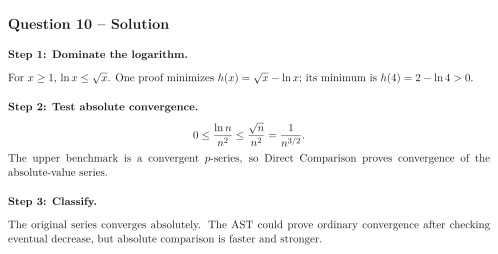
Question 10
Consider .
Prove a useful power bound for .
Use it to test absolute convergence.
Classify the original series and explain why the AST is not needed.
Show solutionHide solution
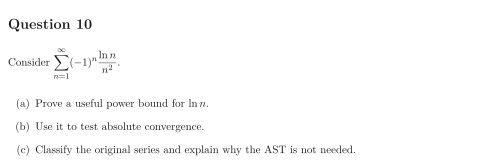
Question 10 – Solution
Step 1: Dominate the logarithm.
For , . One proof minimizes ; its minimum is .
Step 2: Test absolute convergence.
The upper benchmark is a convergent -series, so Direct Comparison proves convergence of the absolute-value series.
Step 3: Classify.
The original series converges absolutely. The AST could prove ordinary convergence after checking eventual decrease, but absolute comparison is faster and stronger.