Question 9
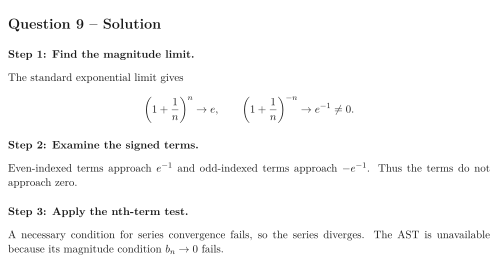
Consider .
Find the limit of the magnitude.
Apply the nth-term test.
Explain why alternating signs cannot rescue the series.
Show solutionHide solution
Question 9 – Solution
Step 1: Find the magnitude limit.
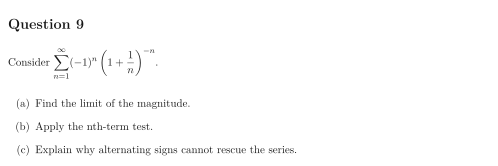
The standard exponential limit gives
Step 2: Examine the signed terms.
Even-indexed terms approach and odd-indexed terms approach . Thus the terms do not approach zero.
Step 3: Apply the nth-term test.
A necessary condition for series convergence fails, so the series diverges. The AST is unavailable because its magnitude condition fails.