Integral Test — Question 6

PDF ↗

Question 6

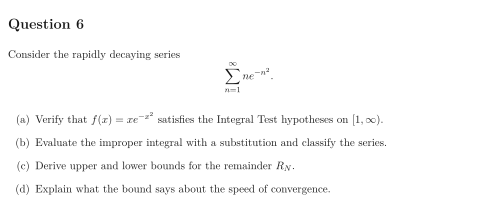
Consider the rapidly decaying series ∑n=1∞ne−n2.\sum_{n=1}^{\infty}n e^{-n^2}.

  1. Verify that f(x)=xe−x2f(x)=xe^{-x^2} satisfies the Integral Test hypotheses on [1,∞)[1,\infty).

  2. Evaluate the improper integral with a substitution and classify the series.

  3. Derive upper and lower bounds for the remainder RNR_N.

  4. Explain what the bound says about the speed of convergence.
Original worksheet page 1: question and worked solution for 4-6-006
Show solutionHide solution

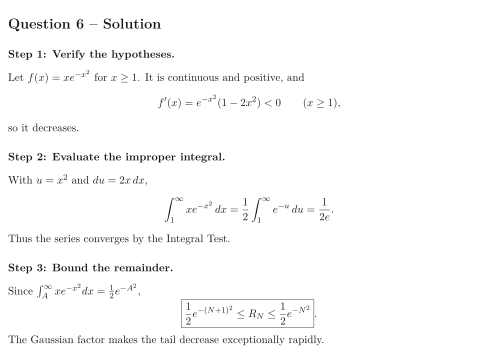
Question 6 – Solution

Step 1: Verify the hypotheses.

Let f(x)=xe−x2f(x)=xe^{-x^2} for x≥1x\ge1. It is continuous and positive, and f′(x)=e−x2(1−2x2)<0(x≥1),f'(x)=e^{-x^2}(1-2x^2)<0\qquad(x\ge1), so it decreases.

Step 2: Evaluate the improper integral.

With u=x2u=x^2 and du=2xdxdu=2x\,dx, ∫1∞xe−x2dx=12∫1∞e−udu=12e.\int_1^{\infty}xe^{-x^2}\,dx =\frac12\int_1^{\infty}e^{-u}\,du=\frac1{2e}. Thus the series converges by the Integral Test.

Step 3: Bound the remainder.

Since ∫A∞xe−x2dx=12e−A2\int_A^\infty xe^{-x^2}dx=\tfrac12e^{-A^2}, 12e−(N+1)2≤RN≤12e−N2.\boxed{\frac12e^{-(N+1)^2}\le R_N\le\frac12e^{-N^2}}. The Gaussian factor makes the tail decrease exceptionally rapidly.
Original worksheet page 2: question and worked solution for 4-6-006

Original worksheet layout. Use Enlarge or open the PDF for a closer view.