Integral Test — Question 5

PDF ↗

Question 5

Consider the nested-logarithm series ∑n=3∞1nln⁡nln⁡(ln⁡n).\sum_{n=3}^{\infty}\frac1{n\ln n\,\ln(\ln n)}.

  1. Explain why starting at n=3n=3 makes the terms positive and well defined.

  2. Verify the Integral Test hypotheses for the corresponding function.

  3. Evaluate the improper integral using two successive logarithmic substitutions.

  4. State the verdict and identify the slow growth expression responsible for it.
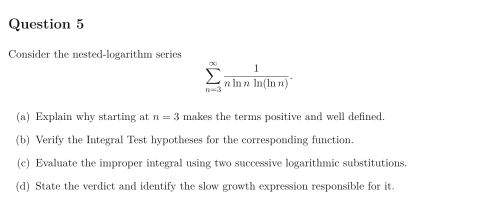
Original worksheet page 1: question and worked solution for 4-6-005
Show solutionHide solution

Question 5 – Solution

Step 1: Check the domain and hypotheses.

Start at n=3n=3 so that ln⁡n>1\ln n>1 and ln⁡(ln⁡n)>0\ln(\ln n)>0. Let f(x)=1xln⁡xln⁡(ln⁡x)(x≥3).f(x)=\frac1{x\ln x\ln(\ln x)}\quad(x\ge3). The denominator is positive, continuous, and strictly increasing, so ff is positive, continuous, and decreasing.

Step 2: Perform two substitutions.

First let u=ln⁡xu=\ln x, du=dx/xdu=dx/x; then let v=ln⁡uv=\ln u, dv=du/udv=du/u: ∫3bdxxln⁡xln⁡(ln⁡x)=∫ln⁡3ln⁡bduuln⁡u=[ln(lnu)]ln⁡3ln⁡b.\int_3^b\frac{dx}{x\ln x\ln(\ln x)} =\int_{\ln3}^{\ln b}\frac{du}{u\ln u} =\left[\ln(\ln u)\right]_{\ln3}^{\ln b}. Thus the antiderivative grows as ln⁡(ln⁡(ln⁡b))\ln(\ln(\ln b)), which tends to infinity.

Step 3: Conclude.

By the Integral Test, ∑n=3∞1nln⁡nln⁡(ln⁡n) diverges.\boxed{\sum_{n=3}^{\infty}\frac1{n\ln n\ln(\ln n)}\text{ diverges}.} This is another borderline series: three nested logarithms still grow without bound.
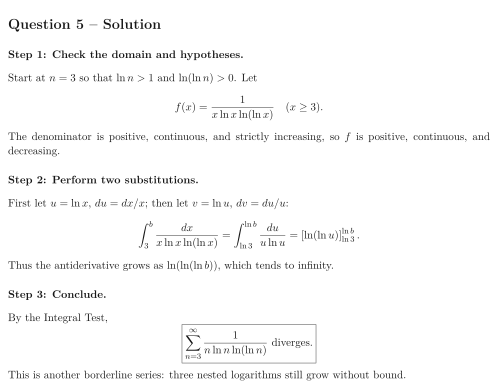
Original worksheet page 2: question and worked solution for 4-6-005

Original worksheet layout. Use Enlarge or open the PDF for a closer view.