Special Series — Question 6
Question 6
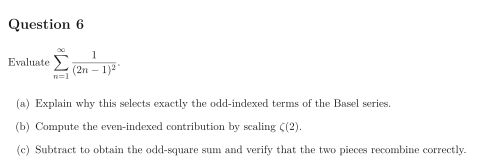
Evaluate
.
Explain why this selects exactly the odd-indexed terms of the
Basel series.
Compute the even-indexed contribution by scaling
.
Subtract to obtain the odd-square sum and verify that the two
pieces recombine correctly.
Show solutionHide solution+
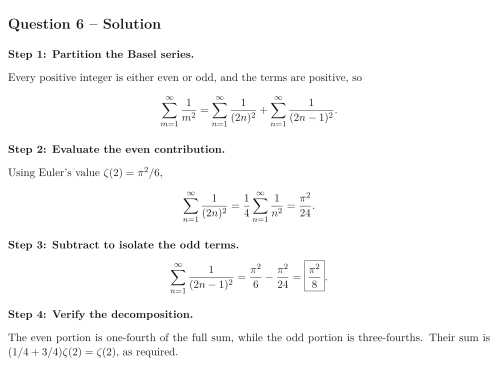
Question 6 –
Solution
Step 1: Partition the Basel
series.
Every positive integer is either even or odd, and the terms are
positive, so
Step 2: Evaluate the
even contribution.
Using Euler’s value
,
Step 3: Subtract to
isolate the odd terms.
Step 4: Verify the
decomposition.
The even portion is one-fourth of the full sum, while the odd portion
is three-fourths. Their sum is
,
as required.
Original worksheet layout. Use Enlarge or open the PDF for a closer view.