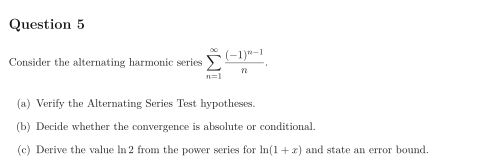
Question 5
Consider the alternating harmonic series .
Verify the Alternating Series Test hypotheses.
Decide whether the convergence is absolute or conditional.
Derive the value from the power series for and state an error bound.
Show solutionHide solution
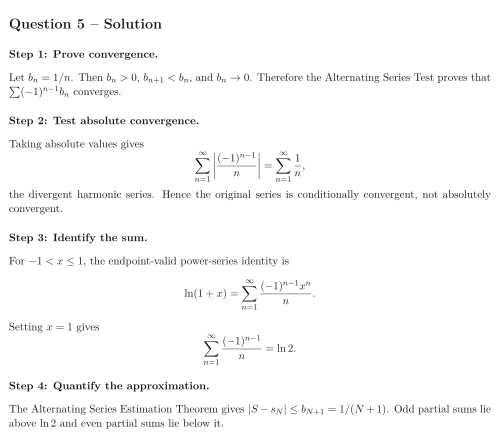
Question 5 – Solution
Step 1: Prove convergence.
Let . Then , , and . Therefore the Alternating Series Test proves that converges.
Step 2: Test absolute convergence.
Taking absolute values gives the divergent harmonic series. Hence the original series is conditionally convergent, not absolutely convergent.
Step 3: Identify the sum.
For , the endpoint-valid power-series identity is Setting gives
Step 4: Quantify the approximation.
The Alternating Series Estimation Theorem gives . Odd partial sums lie above and even partial sums lie below it.