Question 3
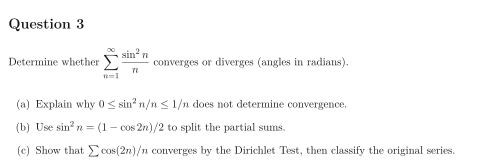
Determine whether converges or diverges (angles in radians).
Explain why does not determine convergence.
Use to split the partial sums.
Show that converges by the Dirichlet Test, then classify the original series.
Show solutionHide solution
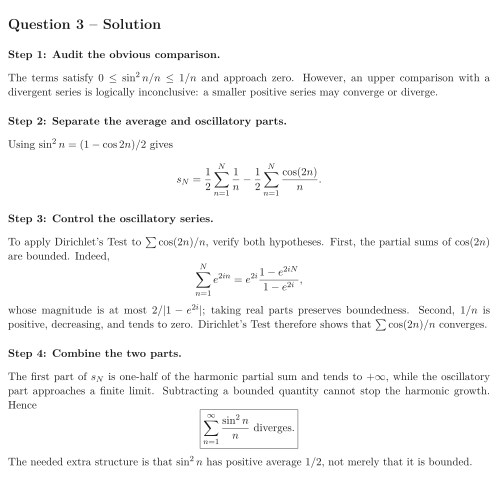
Question 3 – Solution
Step 1: Audit the obvious comparison.
The terms satisfy and approach zero. However, an upper comparison with a divergent series is logically inconclusive: a smaller positive series may converge or diverge.
Step 2: Separate the average and oscillatory parts.
Using gives
Step 3: Control the oscillatory series.
To apply Dirichlet’s Test to , verify both hypotheses. First, the partial sums of are bounded. Indeed, whose magnitude is at most ; taking real parts preserves boundedness. Second, is positive, decreasing, and tends to zero. Dirichlet’s Test therefore shows that converges.
Step 4: Combine the two parts.
The first part of is one-half of the harmonic partial sum and tends to , while the oscillatory part approaches a finite limit. Subtracting a bounded quantity cannot stop the harmonic growth. Hence The needed extra structure is that has positive average , not merely that it is bounded.