Question 2
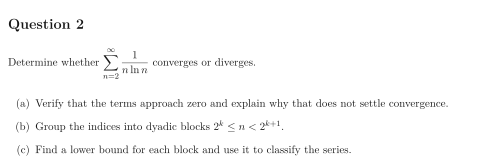
Determine whether converges or diverges.
Verify that the terms approach zero and explain why that does not settle convergence.
Group the indices into dyadic blocks .
Find a lower bound for each block and use it to classify the series.
Show solutionHide solution
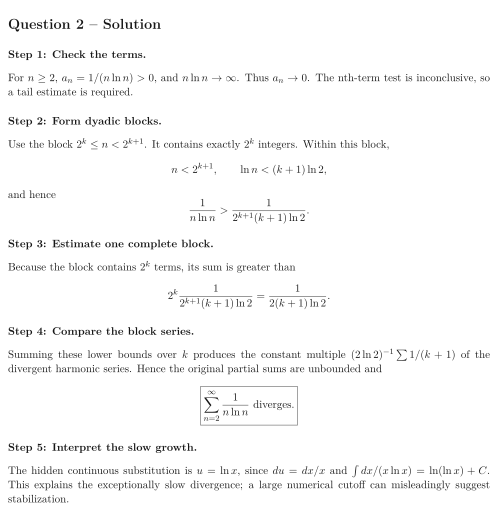
Question 2 – Solution
Step 1: Check the terms.
For , , and . Thus . The nth-term test is inconclusive, so a tail estimate is required.
Step 2: Form dyadic blocks.
Use the block . It contains exactly integers. Within this block, and hence
Step 3: Estimate one complete block.
Because the block contains terms, its sum is greater than
Step 4: Compare the block series.
Summing these lower bounds over produces the constant multiple of the divergent harmonic series. Hence the original partial sums are unbounded and
Step 5: Interpret the slow growth.
The hidden continuous substitution is , since and . This explains the exceptionally slow divergence; a large numerical cutoff can misleadingly suggest stabilization.