Question 10
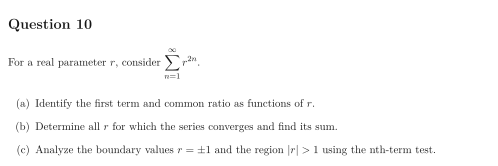
For a real parameter , consider .
Identify the first term and common ratio as functions of .
Determine all for which the series converges and find its sum.
Analyze the boundary values and the region using the nth-term test.
Show solutionHide solution
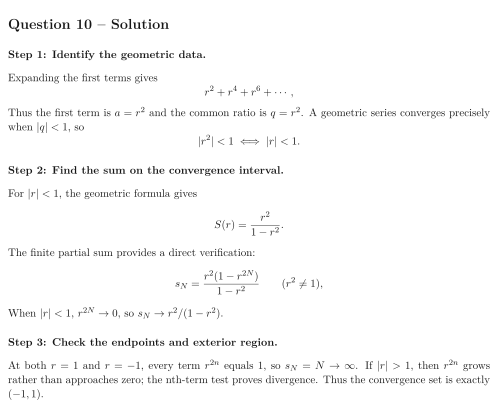
Question 10 – Solution
Step 1: Identify the geometric data.
Expanding the first terms gives Thus the first term is and the common ratio is . A geometric series converges precisely when , so
Step 2: Find the sum on the convergence interval.
For , the geometric formula gives The finite partial sum provides a direct verification: When , , so .
Step 3: Check the endpoints and exterior region.
At both and , every term equals , so . If , then grows rather than approaches zero; the nth-term test proves divergence. Thus the convergence set is exactly .