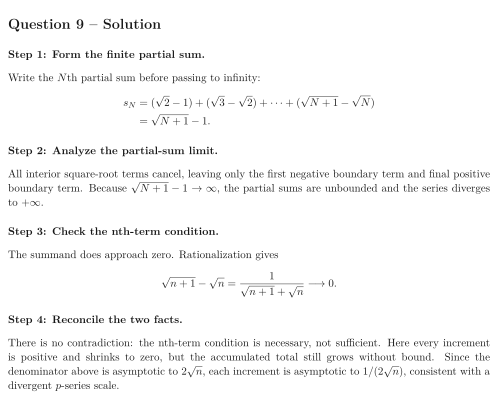
Question 9
Consider .
Write the first four terms and expose the telescoping cancellation.
Derive the th partial sum and determine whether the series converges.
Reconcile the divergence with the fact that the individual terms approach zero.
Show solutionHide solution
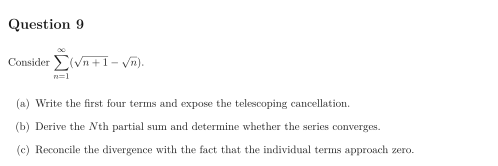
Question 9 – Solution
Step 1: Form the finite partial sum.
Write the th partial sum before passing to infinity:
Step 2: Analyze the partial-sum limit.
All interior square-root terms cancel, leaving only the first negative boundary term and final positive boundary term. Because , the partial sums are unbounded and the series diverges to .
Step 3: Check the nth-term condition.
The summand does approach zero. Rationalization gives
Step 4: Reconcile the two facts.
There is no contradiction: the nth-term condition is necessary, not sufficient. Here every increment is positive and shrinks to zero, but the accumulated total still grows without bound. Since the denominator above is asymptotic to , each increment is asymptotic to , consistent with a divergent -series scale.