Question 7
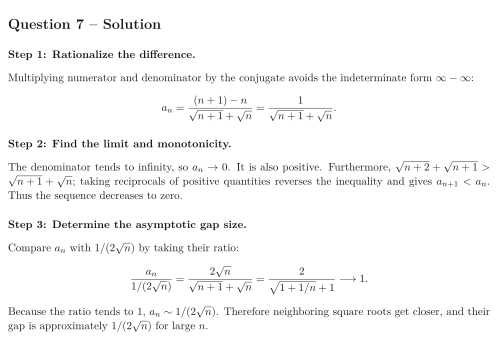
Let .
Rationalize the expression and use the result to find the limit.
Prove that is positive and decreasing.
Show that and interpret this as the spacing between neighboring square roots.
Show solutionHide solution
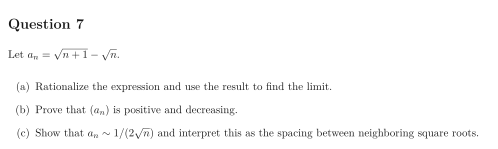
Question 7 – Solution
Step 1: Rationalize the difference.
Multiplying numerator and denominator by the conjugate avoids the indeterminate form :
Step 2: Find the limit and monotonicity.
The denominator tends to infinity, so . It is also positive. Furthermore, ; taking reciprocals of positive quantities reverses the inequality and gives . Thus the sequence decreases to zero.
Step 3: Determine the asymptotic gap size.
Compare with by taking their ratio: Because the ratio tends to , . Therefore neighboring square roots get closer, and their gap is approximately for large .