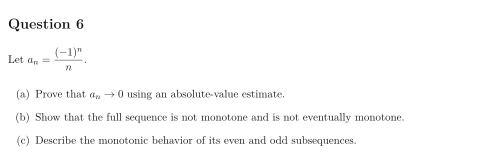
Question 6
Let .
Prove that using an absolute-value estimate.
Show that the full sequence is not monotone and is not eventually monotone.
Describe the monotonic behavior of its even and odd subsequences.
Show solutionHide solution
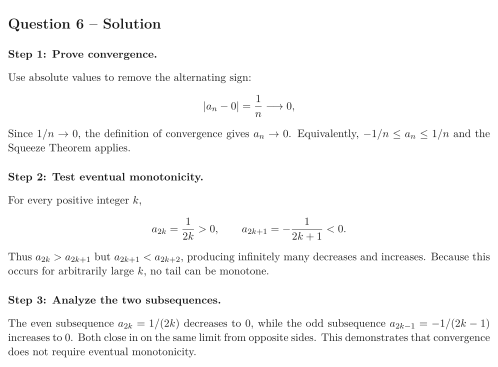
Question 6 – Solution
Step 1: Prove convergence.
Use absolute values to remove the alternating sign: Since , the definition of convergence gives . Equivalently, and the Squeeze Theorem applies.
Step 2: Test eventual monotonicity.
For every positive integer , Thus but , producing infinitely many decreases and increases. Because this occurs for arbitrarily large , no tail can be monotone.
Step 3: Analyze the two subsequences.
The even subsequence decreases to , while the odd subsequence increases to . Both close in on the same limit from opposite sides. This demonstrates that convergence does not require eventual monotonicity.