Question 3
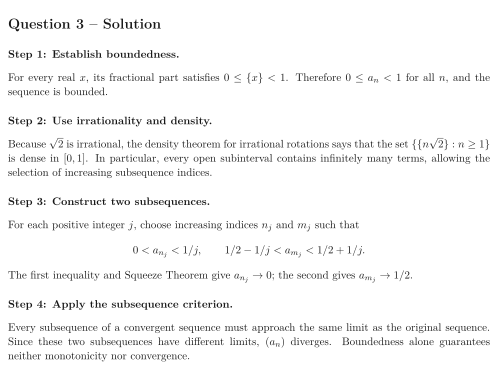
Let .
Prove that , so the sequence is bounded.
Using the fact that the fractional parts of multiples of an irrational number are dense in , find two different subsequential limits.
Decide whether converges and explain why boundedness is insufficient.
Show solutionHide solution
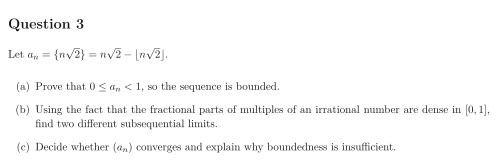
Question 3 – Solution
Step 1: Establish boundedness.
For every real , its fractional part satisfies . Therefore for all , and the sequence is bounded.
Step 2: Use irrationality and density.
Because is irrational, the density theorem for irrational rotations says that the set is dense in . In particular, every open subinterval contains infinitely many terms, allowing the selection of increasing subsequence indices.
Step 3: Construct two subsequences.
For each positive integer , choose increasing indices and such that The first inequality and Squeeze Theorem give ; the second gives .
Step 4: Apply the subsequence criterion.
Every subsequence of a convergent sequence must approach the same limit as the original sequence. Since these two subsequences have different limits, diverges. Boundedness alone guarantees neither monotonicity nor convergence.