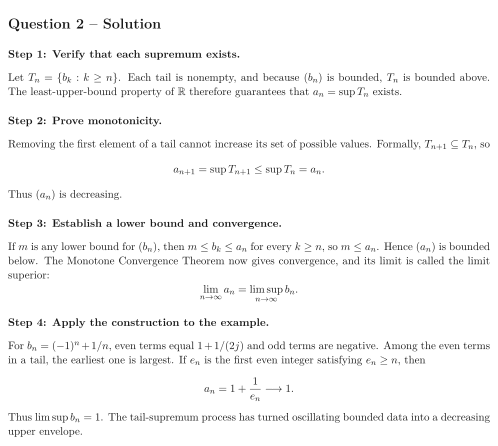
Question 2
Let be a bounded real sequence and define .
Explain why every exists.
Prove that is decreasing and bounded, and hence convergent.
State what its limit represents, and compute it when .
Show solutionHide solution
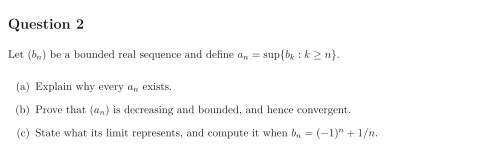
Question 2 – Solution
Step 1: Verify that each supremum exists.
Let . Each tail is nonempty, and because is bounded, is bounded above. The least-upper-bound property of therefore guarantees that exists.
Step 2: Prove monotonicity.
Removing the first element of a tail cannot increase its set of possible values. Formally, , so Thus is decreasing.
Step 3: Establish a lower bound and convergence.
If is any lower bound for , then for every , so . Hence is bounded below. The Monotone Convergence Theorem now gives convergence, and its limit is called the limit superior:
Step 4: Apply the construction to the example.
For , even terms equal and odd terms are negative. Among the even terms in a tail, the earliest one is largest. If is the first even integer satisfying , then Thus . The tail-supremum process has turned oscillating bounded data into a decreasing upper envelope.