Partial Fractions — Question 7

PDF ↗

Question 7

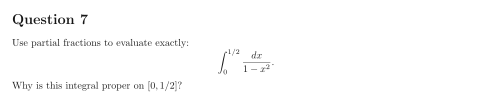
Use partial fractions to evaluate exactly: ∫01/2dx1−x2.\int_0^{1/2}\frac{dx}{1-x^2}. Why is this integral proper on [0,1/2][0,1/2]?

Original worksheet page 1: question and worked solution for 1-4-007
Show solutionHide solution

Question 7 – Solution

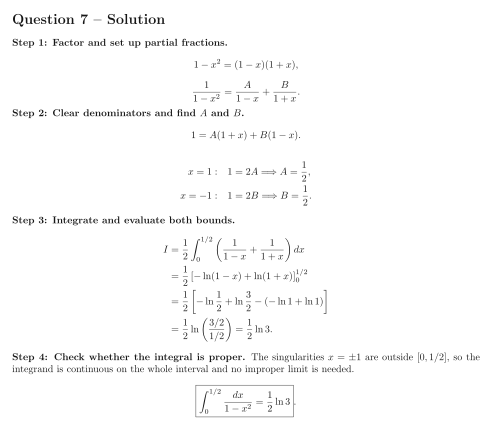
Step 1: Factor and set up partial fractions. 1−x2=(1−x)(1+x),1-x^2=(1-x)(1+x), 11−x2=A1−x+B1+x.\frac1{1-x^2}=\frac{A}{1-x}+\frac{B}{1+x}. Step 2: Clear denominators and find AA and BB. 1=A(1+x)+B(1−x).1=A(1+x)+B(1-x). x=1:1=2A⇒A=12,x=−1:1=2B⇒B=12.\begin{align*} x=1:&\quad 1=2A \Longrightarrow A=\frac12,\\ x=-1:&\quad 1=2B \Longrightarrow B=\frac12. \end{align*} Step 3: Integrate and evaluate both bounds. I=12∫01/2(11−x+11+x)dx=12[−ln(1−x)+ln(1+x)]01/2=12[−ln12+ln32−(−ln1+ln1)]=12ln⁡(3/21/2)=12ln⁡3.\begin{align*} I&=\frac12\int_0^{1/2}\left(\frac1{1-x}+\frac1{1+x}\right)dx\\ &=\frac12\left[-\ln(1-x)+\ln(1+x)\right]_0^{1/2}\\ &=\frac12\left[-\ln\frac12+\ln\frac32-(-\ln1+\ln1)\right]\\ &=\frac12\ln\left(\frac{3/2}{1/2}\right)=\frac12\ln3. \end{align*} Step 4: Check whether the integral is proper. The singularities x=±1x=\pm1 are outside [0,1/2][0,1/2], so the integrand is continuous on the whole interval and no improper limit is needed. ∫01/2dx1−x2=12ln⁡3.\boxed{\displaystyle \int_0^{1/2}\frac{dx}{1-x^2}=\frac12\ln3}.

Original worksheet page 2: question and worked solution for 1-4-007

Original worksheet layout. Use Enlarge or open the PDF for a closer view.