Partial Fractions — Question 6

PDF ↗

Question 6

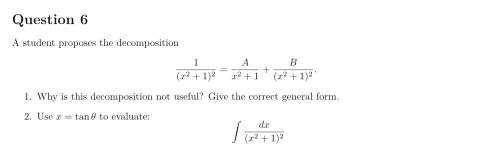
A student proposes the decomposition 1(x2+1)2=Ax2+1+B(x2+1)2.\frac1{(x^2+1)^2} =\frac{A}{x^2+1}+\frac{B}{(x^2+1)^2}.

  1. Why is this decomposition not useful? Give the correct general form.

  2. Use x=tan⁡θx=\tan\theta to evaluate: ∫dx(x2+1)2\int\frac{dx}{(x^2+1)^2}

Original worksheet page 1: question and worked solution for 1-4-006
Show solutionHide solution

Question 6 – Solution

Part 1: Check the decomposition.

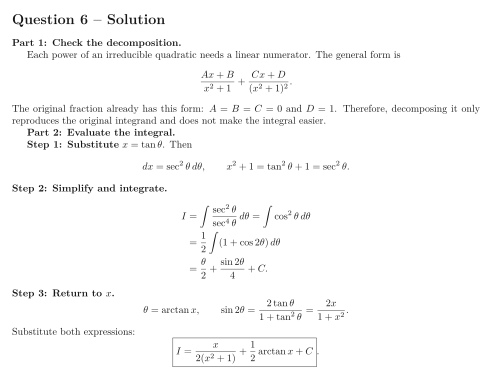
Each power of an irreducible quadratic needs a linear numerator. The general form is Ax+Bx2+1+Cx+D(x2+1)2.\frac{Ax+B}{x^2+1}+\frac{Cx+D}{(x^2+1)^2}. The original fraction already has this form: A=B=C=0A=B=C=0 and D=1D=1. Therefore, decomposing it only reproduces the original integrand and does not make the integral easier.

Part 2: Evaluate the integral.

Step 1: Substitute x=tan⁡θx=\tan\theta. Then dx=sec⁡2θdθ,x2+1=tan⁡2θ+1=sec⁡2θ.dx=\sec^2\theta\,d\theta, \qquad x^2+1=\tan^2\theta+1=\sec^2\theta. Step 2: Simplify and integrate. I=∫sec⁡2θsec⁡4θdθ=∫cos⁡2θdθ=12∫(1+cos⁡2θ)dθ=θ2+sin⁡2θ4+C.\begin{align*} I&=\int\frac{\sec^2\theta}{\sec^4\theta}\,d\theta =\int\cos^2\theta\,d\theta\\ &=\frac12\int(1+\cos2\theta)\,d\theta\\ &=\frac{\theta}{2}+\frac{\sin2\theta}{4}+C. \end{align*} Step 3: Return to xx. θ=arctan⁡x,sin⁡2θ=2tan⁡θ1+tan⁡2θ=2x1+x2.\theta=\arctan x,\qquad \sin2\theta=\frac{2\tan\theta}{1+\tan^2\theta}=\frac{2x}{1+x^2}. Substitute both expressions: I=x2(x2+1)+12arctan⁡x+C.\boxed{\displaystyle I=\frac{x}{2(x^2+1)} +\frac12\arctan x+C}.

Original worksheet page 2: question and worked solution for 1-4-006

Original worksheet layout. Use Enlarge or open the PDF for a closer view.