Constant of Integration — Question 5

PDF ↗

Question 5

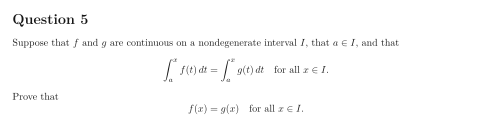
Suppose that ff and gg are continuous on a nondegenerate interval II, that a∈Ia\in I, and that ∫axf(t)dt=∫axg(t)dtfor all x∈I.\int_a^x f(t)\,dt = \int_a^x g(t)\,dt \quad\text{for all }x\in I. Prove that f(x)=g(x)for all x∈I.f(x)=g(x) \quad\text{for all }x\in I.

Original worksheet page 1: question and worked solution for 7-9-005
Show solutionHide solution

Question 5 - Solution

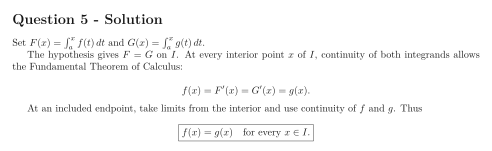
Set F(x)=∫axf(t)dtF(x)=\int_a^x f(t)\,dt and G(x)=∫axg(t)dtG(x)=\int_a^x g(t)\,dt.

The hypothesis gives F=GF=G on II. At every interior point xx of II, continuity of both integrands allows the Fundamental Theorem of Calculus:

f(x)=F′(x)=G′(x)=g(x).f(x)=F'(x)=G'(x)=g(x).

At an included endpoint, take limits from the interior and use continuity of ff and gg. Thus

f(x)=g(x)for every x∈I.\boxed{f(x)=g(x)\quad\text{for every }x\in I.}

Original worksheet page 2: question and worked solution for 7-9-005

Original worksheet layout. Use Enlarge or open the PDF for a closer view.