Types of Infinity — Question 8

PDF ↗

Question 8

Prove that limx→∞(ln(x+1)−lnx)=0.\lim_{x\to\infty}\left(\ln(x+1)-\ln x\right)=0.

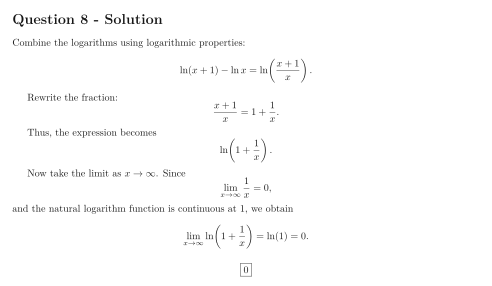
Original worksheet page 1: question and worked solution for 7-7-008
Show solutionHide solution

Question 8 - Solution

Combine the logarithms using logarithmic properties: ln⁡(x+1)−ln⁡x=ln⁡(x+1x).\ln(x+1)-\ln x=\ln\!\left(\frac{x+1}{x}\right).

Rewrite the fraction: x+1x=1+1x.\frac{x+1}{x}=1+\frac{1}{x}.

Thus, the expression becomes ln⁡(1+1x).\ln\!\left(1+\frac{1}{x}\right).

Now take the limit as x→∞x\to\infty. Since limx→∞1x=0,\lim_{x\to\infty}\frac{1}{x}=0, and the natural logarithm function is continuous at 11, we obtain limx→∞ln⁡(1+1x)=ln⁡(1)=0.\lim_{x\to\infty}\ln\!\left(1+\frac{1}{x}\right)=\ln(1)=0.

0\boxed{0}

Original worksheet page 2: question and worked solution for 7-7-008

Original worksheet layout. Use Enlarge or open the PDF for a closer view.