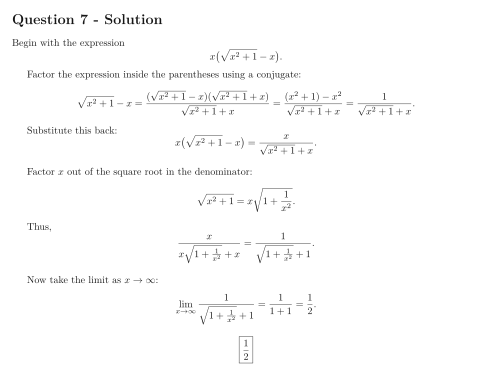
Question 7 Prove that limx→∞x(x2+1−x)=12.\lim_{x\to\infty} x\bigl(\sqrt{x^2+1}-x\bigr)=\frac{1}{2}. Show solutionHide solution+Question 7 - Solution Begin with the expression x(x2+1−x).x\bigl(\sqrt{x^2+1}-x\bigr). Factor the expression inside the parentheses using a conjugate: x2+1−x=(x2+1−x)(x2+1+x)x2+1+x=(x2+1)−x2x2+1+x=1x2+1+x.\sqrt{x^2+1}-x = \frac{(\sqrt{x^2+1}-x)(\sqrt{x^2+1}+x)}{\sqrt{x^2+1}+x} = \frac{(x^2+1)-x^2}{\sqrt{x^2+1}+x} = \frac{1}{\sqrt{x^2+1}+x}. Substitute this back: x(x2+1−x)=xx2+1+x.x\bigl(\sqrt{x^2+1}-x\bigr) = \frac{x}{\sqrt{x^2+1}+x}. Factor xx out of the square root in the denominator: x2+1=x1+1x2.\sqrt{x^2+1} = x\sqrt{1+\frac{1}{x^2}}. Thus, xx1+1x2+x=11+1x2+1.\frac{x}{x\sqrt{1+\frac{1}{x^2}}+x} = \frac{1}{\sqrt{1+\frac{1}{x^2}}+1}. Now take the limit as x→∞x\to\infty: limx→∞11+1x2+1=11+1=12.\lim_{x\to\infty} \frac{1}{\sqrt{1+\frac{1}{x^2}}+1} = \frac{1}{1+1} = \frac{1}{2}. 12\boxed{\frac{1}{2}}