Work — Question 3

PDF ↗

Question 3

A force acting on an object is given by F(x)=101+x2(newtons),F(x)=\frac{10}{1+x^2} \quad \text{(newtons)}, where xx is the distance (in meters) the object has moved along a straight line. Find the work done in moving the object from x=0x=0 to x=2x=2.

See the diagram in the original worksheet below.

The shaded area represents work over the specified interval.

Original worksheet page 1: question and worked solution for 6-6-003
Show solutionHide solution

Question 3 – Solution

1. Identify the work model.

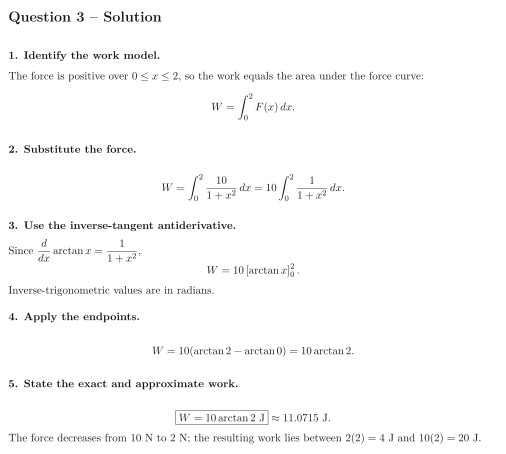
The force is positive over 0≤x≤20\le x\le2, so the work equals the area under the force curve:W=∫02F(x)dx.W=\int_0^2F(x)\,dx.

2. Substitute the force.

W=∫02101+x2dx=10∫0211+x2dx.W=\int_0^2\frac{10}{1+x^2}\,dx=10\int_0^2\frac1{1+x^2}\,dx.

3. Use the inverse-tangent antiderivative.

Since ddxarctan⁡x=11+x2\dfrac{d}{dx}\arctan x=\dfrac1{1+x^2},W=10[arctanx]02.W=10\left[\arctan x\right]_0^2.Inverse-trigonometric values are in radians.

4. Apply the endpoints.

W=10(arctan⁡2−arctan⁡0)=10arctan⁡2.W=10(\arctan2-\arctan0)=10\arctan2.

5. State the exact and approximate work.

W=10arctan⁡2J≈11.0715J.\boxed{W=10\arctan2\ \mathrm{J}}\approx11.0715\ \mathrm{J}.The force decreases from 1010 N to 22 N; the resulting work lies between 2(2)=42(2)=4 J and 10(2)=2010(2)=20 J.

Original worksheet page 2: question and worked solution for 6-6-003

Original worksheet layout. Use Enlarge or open the PDF for a closer view.