Question 2
A spring has natural length m. A force of N is required to stretch the spring to a length of m.
Find the work required to stretch the spring from its natural length to a length of m.
See the diagram in the original worksheet below.
The shaded area represents work over the specified interval.

Show solutionHide solution
Question 2 – Solution
1. Use extension beyond natural length.
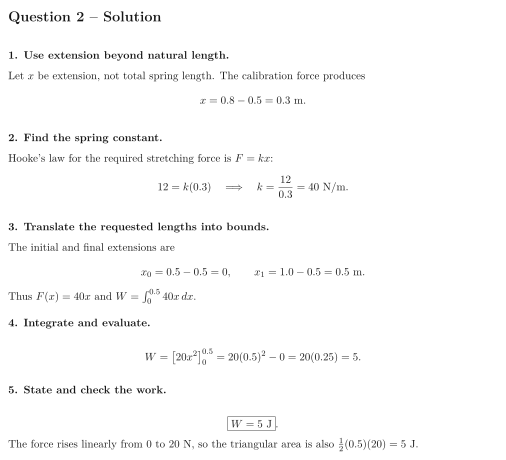
Let be extension, not total spring length. The calibration force produces
2. Find the spring constant.
Hooke’s law for the required stretching force is :
3. Translate the requested lengths into bounds.
The initial and final extensions areThus and .
4. Integrate and evaluate.
5. State and check the work.
The force rises linearly from to N, so the triangular area is also J.