Question 8
The base of a solid is the region bounded by Cross-sections perpendicular to the -axis are squares. Find the volume of the solid.
See the diagram in the original worksheet below.
Shaded base region in the -plane.
Cross-section perpendicular to the -axis
See the diagram in the original worksheet below.
Schematic cross-section; dimensions vary with .

Show solutionHide solution
Question 8 – Solution
1. Determine the bounds.
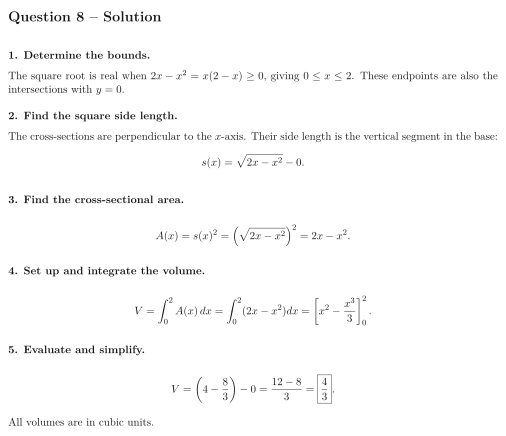
The square root is real when , giving . These endpoints are also the intersections with .
2. Find the square side length.
The cross-sections are perpendicular to the -axis. Their side length is the vertical segment in the base:
3. Find the cross-sectional area.
4. Set up and integrate the volume.
5. Evaluate and simplify.
All volumes are in cubic units.