Question 7
The base of a solid is the region bounded by between their points of intersection. Cross-sections perpendicular to the -axis are right triangles whose height is equal to the base. Find the volume of the solid.
See the diagram in the original worksheet below.
Shaded base region in the -plane.
Cross-section perpendicular to the -axis
See the diagram in the original worksheet below.
Schematic cross-section; dimensions vary with .

Show solutionHide solution
Question 7 – Solution
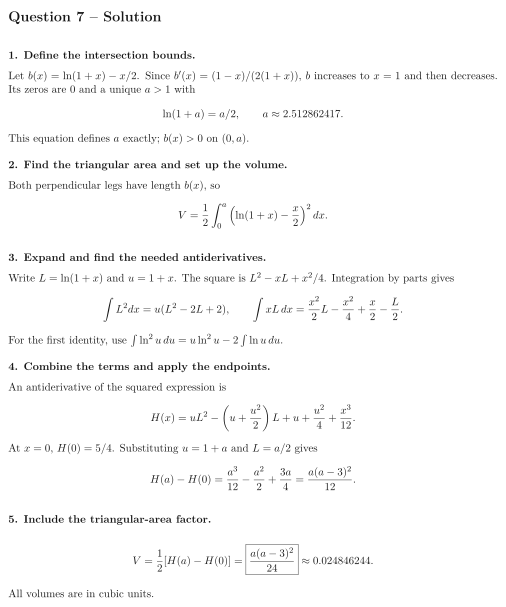
1. Define the intersection bounds.
Let . Since , increases to and then decreases. Its zeros are and a unique withThis equation defines exactly; on .
2. Find the triangular area and set up the volume.
Both perpendicular legs have length , so
3. Expand and find the needed antiderivatives.
Write and . The square is . Integration by parts givesFor the first identity, use .
4. Combine the terms and apply the endpoints.
An antiderivative of the squared expression isAt , . Substituting and gives
5. Include the triangular-area factor.
All volumes are in cubic units.