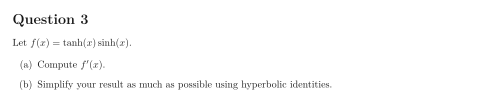
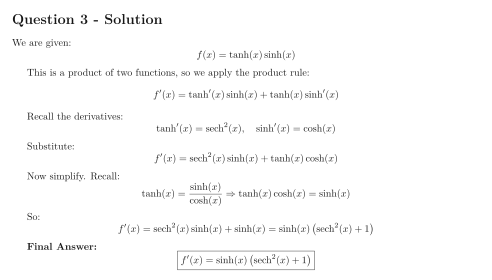
Question 3 Let f(x)=tanh(x)sinh(x)f(x) = \tanh(x)\sinh(x). (a) Compute f′(x)f'(x). (b) Simplify your result as much as possible using hyperbolic identities. Show solutionHide solution+Question 3 - Solution We are given: f(x)=tanh(x)sinh(x)f(x) = \tanh(x)\sinh(x) This is a product of two functions, so we apply the product rule: f′(x)=tanh′(x)sinh(x)+tanh(x)sinh′(x)f'(x) = \tanh'(x)\sinh(x) + \tanh(x)\sinh'(x) Recall the derivatives: tanh′(x)=sech2(x),sinh′(x)=cosh(x)\tanh'(x) = \text{sech}^2(x), \quad \sinh'(x) = \cosh(x) Substitute: f′(x)=sech2(x)sinh(x)+tanh(x)cosh(x)f'(x) = \text{sech}^2(x)\sinh(x) + \tanh(x)\cosh(x) Now simplify. Recall: tanh(x)=sinh(x)cosh(x)⇒tanh(x)cosh(x)=sinh(x)\tanh(x) = \frac{\sinh(x)}{\cosh(x)} \Rightarrow \tanh(x)\cosh(x) = \sinh(x) So: f′(x)=sech2(x)sinh(x)+sinh(x)=sinh(x)(sech2(x)+1)f'(x) = \text{sech}^2(x)\sinh(x) + \sinh(x) = \sinh(x)\left( \text{sech}^2(x) + 1 \right) Final Answer: f′(x)=sinh(x)(sech2(x)+1)\boxed{f'(x) = \sinh(x)\left( \text{sech}^2(x) + 1 \right)}