Derivatives of Inverse Trig Functions — Question 4

PDF ↗

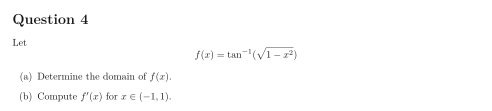
Question 4

Let f(x)=tan⁡−1(1−x2)f(x) = \tan^{-1}(\sqrt{1 - x^2})

  • (a) Determine the domain of f(x)f(x).

  • (b) Compute f′(x)f'(x) for x∈(−1,1)x \in (-1, 1).

Original worksheet page 1: question and worked solution for 3-7-004
Show solutionHide solution

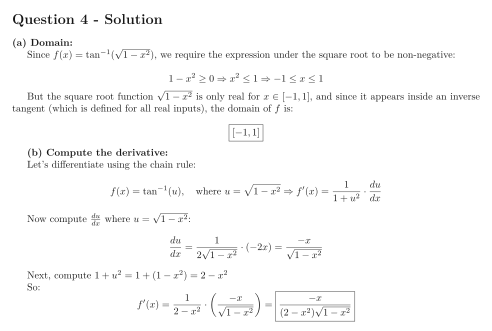
Question 4 - Solution

(a) Domain:

Since f(x)=tan⁡−1(1−x2)f(x) = \tan^{-1}(\sqrt{1 - x^2}), we require the expression under the square root to be non-negative:

1−x2≥0⇒x2≤1⇒−1≤x≤11 - x^2 \geq 0 \Rightarrow x^2 \leq 1 \Rightarrow -1 \leq x \leq 1

But the square root function 1−x2\sqrt{1 - x^2} is only real for x∈[−1,1]x \in [-1, 1], and since it appears inside an inverse tangent (which is defined for all real inputs), the domain of ff is:

[−1,1]\boxed{[-1, 1]}

(b) Compute the derivative:

Let’s differentiate using the chain rule: f(x)=tan⁡−1(u),where u=1−x2⇒f′(x)=11+u2⋅dudxf(x) = \tan^{-1}(u), \quad \text{where } u = \sqrt{1 - x^2} \Rightarrow f'(x) = \frac{1}{1 + u^2} \cdot \frac{du}{dx}

Now compute dudx\frac{du}{dx} where u=1−x2u = \sqrt{1 - x^2}: dudx=121−x2⋅(−2x)=−x1−x2\frac{du}{dx} = \frac{1}{2\sqrt{1 - x^2}} \cdot (-2x) = \frac{-x}{\sqrt{1 - x^2}}

Next, compute 1+u2=1+(1−x2)=2−x21 + u^2 = 1 + (1 - x^2) = 2 - x^2

So: f′(x)=12−x2⋅(−x1−x2)=−x(2−x2)1−x2f'(x) = \frac{1}{2 - x^2} \cdot \left( \frac{-x}{\sqrt{1 - x^2}} \right) = \boxed{\frac{-x}{(2 - x^2)\sqrt{1 - x^2}}}

Original worksheet page 2: question and worked solution for 3-7-004

Original worksheet layout. Use Enlarge or open the PDF for a closer view.