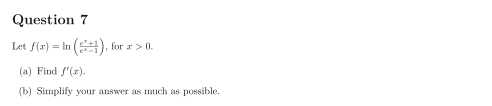
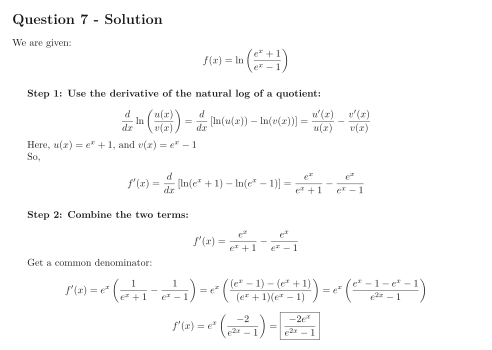
Question 7 Let f(x)=ln(ex+1ex−1)f(x) = \ln\left(\frac{e^x + 1}{e^x - 1}\right), for x>0x > 0. (a) Find f′(x)f'(x). (b) Simplify your answer as much as possible. Show solutionHide solution+Question 7 - Solution We are given: f(x)=ln(ex+1ex−1)f(x) = \ln\left( \frac{e^x + 1}{e^x - 1} \right) Step 1: Use the derivative of the natural log of a quotient: ddxln(u(x)v(x))=ddx[ln(u(x))−ln(v(x))]=u′(x)u(x)−v′(x)v(x)\frac{d}{dx} \ln\left( \frac{u(x)}{v(x)} \right) = \frac{d}{dx} \left[ \ln(u(x)) - \ln(v(x)) \right] = \frac{u'(x)}{u(x)} - \frac{v'(x)}{v(x)} Here, u(x)=ex+1u(x) = e^x + 1, and v(x)=ex−1v(x) = e^x - 1 So, f′(x)=ddx[ln(ex+1)−ln(ex−1)]=exex+1−exex−1f'(x) = \frac{d}{dx} \left[ \ln(e^x + 1) - \ln(e^x - 1) \right] = \frac{e^x}{e^x + 1} - \frac{e^x}{e^x - 1} Step 2: Combine the two terms: f′(x)=exex+1−exex−1f'(x) = \frac{e^x}{e^x + 1} - \frac{e^x}{e^x - 1} Get a common denominator: f′(x)=ex(1ex+1−1ex−1)=ex((ex−1)−(ex+1)(ex+1)(ex−1))=ex(ex−1−ex−1e2x−1)f'(x) = e^x \left( \frac{1}{e^x + 1} - \frac{1}{e^x - 1} \right) = e^x \left( \frac{(e^x - 1) - (e^x + 1)}{(e^x + 1)(e^x - 1)} \right) = e^x \left( \frac{e^x - 1 - e^x - 1}{e^{2x} - 1} \right) f′(x)=ex(−2e2x−1)=−2exe2x−1f'(x) = e^x \left( \frac{-2}{e^{2x} - 1} \right) = \boxed{ \frac{-2e^x}{e^{2x} - 1} }