Derivatives of Exponential and Logarithm Functions — Question 6

PDF ↗

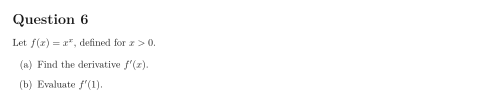
Question 6

Let f(x)=xxf(x) = x^x, defined for x>0x > 0.

  • (a) Find the derivative f′(x)f'(x).

  • (b) Evaluate f′(1)f'(1).

Original worksheet page 1: question and worked solution for 3-6-006
Show solutionHide solution

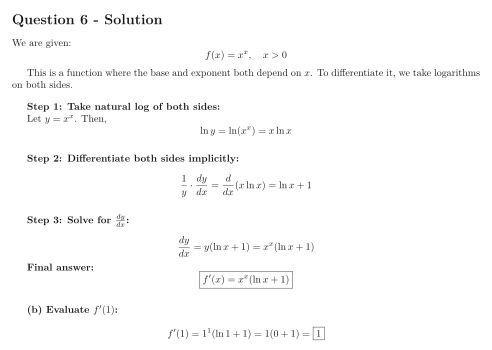
Question 6 - Solution

We are given: f(x)=xx,x>0f(x) = x^x, \quad x > 0

This is a function where the base and exponent both depend on xx. To differentiate it, we take logarithms on both sides.

Step 1: Take natural log of both sides:

Let y=xxy = x^x. Then, ln⁡y=ln⁡(xx)=xln⁡x\ln y = \ln(x^x) = x \ln x

Step 2: Differentiate both sides implicitly:

1y⋅dydx=ddx(xln⁡x)=ln⁡x+1\frac{1}{y} \cdot \frac{dy}{dx} = \frac{d}{dx}(x \ln x) = \ln x + 1

Step 3: Solve for dydx\frac{dy}{dx}:

dydx=y(ln⁡x+1)=xx(ln⁡x+1)\frac{dy}{dx} = y(\ln x + 1) = x^x (\ln x + 1)

Final answer: f′(x)=xx(ln⁡x+1)\boxed{f'(x) = x^x (\ln x + 1)}

(b) Evaluate f′(1)f'(1):

f′(1)=11(ln⁡1+1)=1(0+1)=1f'(1) = 1^1 (\ln 1 + 1) = 1(0 + 1) = \boxed{1}

Original worksheet page 2: question and worked solution for 3-6-006

Original worksheet layout. Use Enlarge or open the PDF for a closer view.