Derivatives of Exponential and Logarithm Functions — Question 4

PDF ↗

Question 4

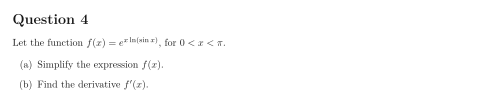
Let the function f(x)=exln⁡(sin⁡x)f(x) = e^{x \ln(\sin x)}, for 0<x<π0 < x < \pi.

  • (a) Simplify the expression f(x)f(x).

  • (b) Find the derivative f′(x)f'(x).

Original worksheet page 1: question and worked solution for 3-6-004
Show solutionHide solution

Question 4 - Solution

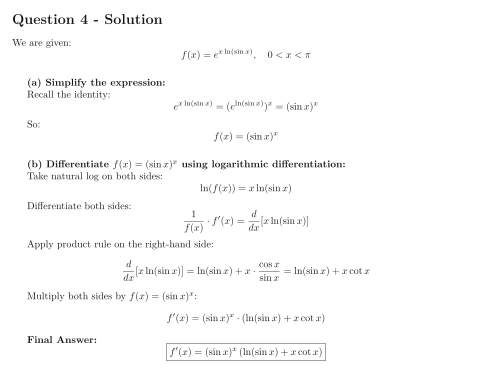
We are given: f(x)=exln⁡(sin⁡x),0<x<πf(x) = e^{x \ln(\sin x)}, \quad 0 < x < \pi

(a) Simplify the expression:

Recall the identity: exln⁡(sin⁡x)=(eln⁡(sin⁡x))x=(sin⁡x)xe^{x \ln(\sin x)} = (e^{\ln(\sin x)})^x = (\sin x)^x

So: f(x)=(sin⁡x)xf(x) = (\sin x)^x

(b) Differentiate f(x)=(sin⁡x)xf(x) = (\sin x)^x using logarithmic differentiation:

Take natural log on both sides: ln⁡(f(x))=xln⁡(sin⁡x)\ln(f(x)) = x \ln(\sin x)

Differentiate both sides: 1f(x)⋅f′(x)=ddx[xln⁡(sin⁡x)]\frac{1}{f(x)} \cdot f'(x) = \frac{d}{dx}[x \ln(\sin x)]

Apply product rule on the right-hand side: ddx[xln⁡(sin⁡x)]=ln⁡(sin⁡x)+x⋅cos⁡xsin⁡x=ln⁡(sin⁡x)+xcot⁡x\frac{d}{dx}[x \ln(\sin x)] = \ln(\sin x) + x \cdot \frac{\cos x}{\sin x} = \ln(\sin x) + x \cot x

Multiply both sides by f(x)=(sin⁡x)xf(x) = (\sin x)^x: f′(x)=(sin⁡x)x⋅(ln(sinx)+xcotx)f'(x) = (\sin x)^x \cdot \left( \ln(\sin x) + x \cot x \right)

Final Answer: f′(x)=(sin⁡x)x(ln(sinx)+xcotx)\boxed{f'(x) = (\sin x)^x \left( \ln(\sin x) + x \cot x \right)}

Original worksheet page 2: question and worked solution for 3-6-004

Original worksheet layout. Use Enlarge or open the PDF for a closer view.