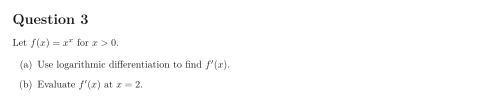
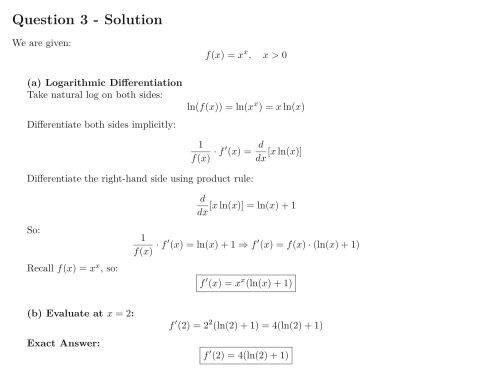
Question 3 Let f(x)=xxf(x) = x^{x} for x>0x > 0. (a) Use logarithmic differentiation to find f′(x)f'(x). (b) Evaluate f′(x)f'(x) at x=2x = 2. Show solutionHide solution+Question 3 - Solution We are given: f(x)=xx,x>0f(x) = x^{x}, \quad x > 0 (a) Logarithmic Differentiation Take natural log on both sides: ln(f(x))=ln(xx)=xln(x)\ln(f(x)) = \ln(x^x) = x \ln(x) Differentiate both sides implicitly: 1f(x)⋅f′(x)=ddx[xln(x)]\frac{1}{f(x)} \cdot f'(x) = \frac{d}{dx}[x \ln(x)] Differentiate the right-hand side using product rule: ddx[xln(x)]=ln(x)+1\frac{d}{dx}[x \ln(x)] = \ln(x) + 1 So: 1f(x)⋅f′(x)=ln(x)+1⇒f′(x)=f(x)⋅(ln(x)+1)\frac{1}{f(x)} \cdot f'(x) = \ln(x) + 1 \Rightarrow f'(x) = f(x) \cdot (\ln(x) + 1) Recall f(x)=xxf(x) = x^x, so: f′(x)=xx(ln(x)+1)\boxed{f'(x) = x^x(\ln(x) + 1)} (b) Evaluate at x=2x = 2: f′(2)=22(ln(2)+1)=4(ln(2)+1)f'(2) = 2^2(\ln(2) + 1) = 4(\ln(2) + 1) Exact Answer: f′(2)=4(ln(2)+1)\boxed{f'(2) = 4(\ln(2) + 1)}