Question 10
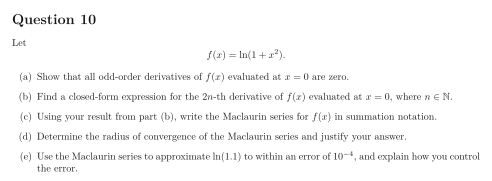
Let
(a) Show that all odd-order derivatives of evaluated at are zero.
(b) Find a closed-form expression for the -th derivative of evaluated at , where .
(c) Using your result from part (b), write the Maclaurin series for in summation notation.
(d) Determine the radius of convergence of the Maclaurin series and justify your answer.
(e) Use the Maclaurin series to approximate to within an error of , and explain how you control the error.
Show solutionHide solution
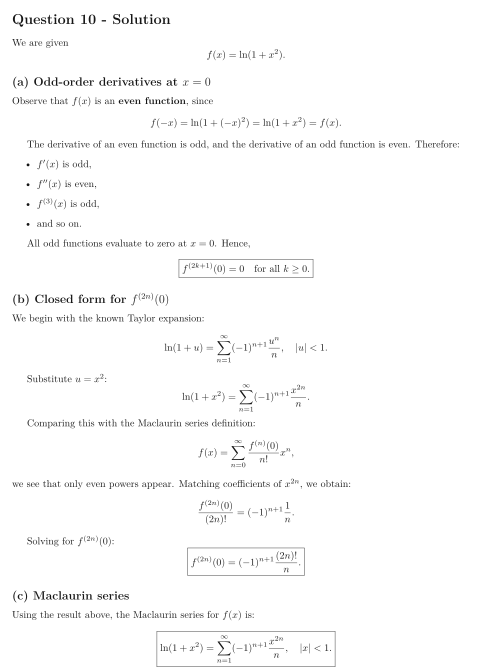
Question 10 - Solution
We are given
(a) Odd-order derivatives at
Observe that is an even function, since
The derivative of an even function is odd, and the derivative of an odd function is even. Therefore:
is odd,
is even,
is odd,
and so on.
All odd functions evaluate to zero at . Hence,
(b) Closed form for
We begin with the known Taylor expansion:
Substitute :
Comparing this with the Maclaurin series definition: we see that only even powers appear. Matching coefficients of , we obtain:
Solving for :
(c) Maclaurin series
Using the result above, the Maclaurin series for is:
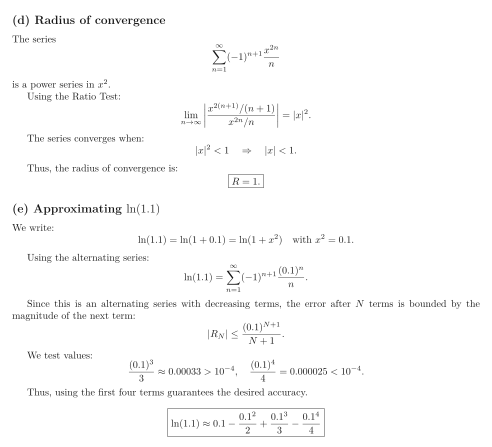
(d) Radius of convergence
The series is a power series in .
Using the Ratio Test:
The series converges when:
Thus, the radius of convergence is:
(e) Approximating
We write:
Using the alternating series:
Since this is an alternating series with decreasing terms, the error after terms is bounded by the magnitude of the next term:
We test values:
Thus, using the first four terms guarantees the desired accuracy.