Higher Order Derivatives — Question 9

PDF ↗

Question 9

Let f(x)=cos⁡(2x)f(x) = \cos(2x).

  • (a) Find the first four derivatives of f(x)f(x).

  • (b) Find a general formula for the nn-th derivative f(n)(x)f^{(n)}(x).

  • (c) Evaluate f(15)(x)f^{(15)}(x).

Original worksheet page 1: question and worked solution for 3-12-009
Show solutionHide solution

Question 9 - Solution

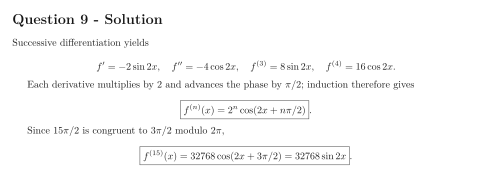
Successive differentiation yields

f′=−2sin⁡2x,f″=−4cos⁡2x,f(3)=8sin⁡2x,f(4)=16cos⁡2x.f'=-2\sin2x,\quad f''=-4\cos2x,\quad f^{(3)}=8\sin2x,\quad f^{(4)}=16\cos2x.

Each derivative multiplies by 22 and advances the phase by π/2\pi/2; induction therefore gives

f(n)(x)=2ncos⁡(2x+nπ/2).\boxed{f^{(n)}(x)=2^n\cos(2x+n\pi/2)}.

Since 15π/215\pi/2 is congruent to 3π/23\pi/2 modulo 2π2\pi,

f(15)(x)=32768cos⁡(2x+3π/2)=32768sin⁡2x.\boxed{f^{(15)}(x)=32768\cos(2x+3\pi/2)=32768\sin2x}.

Original worksheet page 2: question and worked solution for 3-12-009

Original worksheet layout. Use Enlarge or open the PDF for a closer view.