Question 5
On the square , let
Tasks
Derive the product eigenfunctions and explain why the two active products have the same decay rate. Construct .
Determine whether is separable as and whether its nonzero spatial profile can be written as . Prove both conclusions.
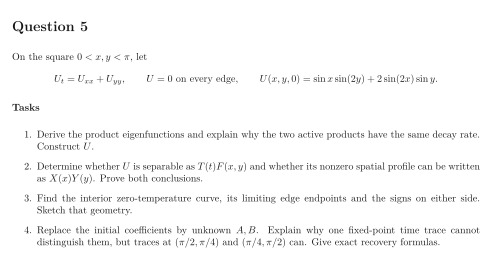
Find the interior zero-temperature curve, its limiting edge endpoints and the signs on either side. Sketch that geometry.
Replace the initial coefficients by unknown . Explain why one fixed-point time trace cannot distinguish them, but traces at and can. Give exact recovery formulas.
Show solutionHide solution
Question 5 – Solution
Strategy. A repeated eigenvalue allows a common time factor without forcing the spatial combination to be a single coordinate product.
Step 1: Identify the repeated eigenvalue. Zero edges give with eigenvalues . The pairs and both give five. Therefore Every edge and the initial field are correct, and applying the Laplacian multiplies the bracket by .
Step 2: Distinguish two meanings of separation. The displayed formula is exactly one product . It is not one product . Indeed, the spatial slice at is , whereas at it is . These two nonzero slices are not proportional by sine orthogonality, as they would have to be for .
Step 3: Determine the nodal geometry. Factor the bracket as . The first two factors are positive inside the square, so the interior zero set is Its limiting endpoints are and . At fixed , the field is positive for and negative to its right. The zero curve is unchanged by the positive decay factor.
Step 4: Resolve the equal-rate inverse problem. At any one sensor, the entire trace has the form with fixed spatial factors ; it supplies only one scalar equation. At the two specified sensors the unwanted product vanishes and the wanted product equals one. Hence Distinct time samples at one point cannot separate equal decay rates; spatially independent observations can.
See the diagram in the original worksheet below.