Question 5
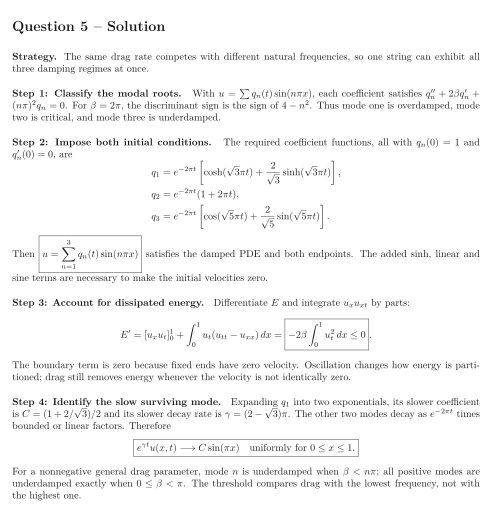
A unit string with fixed ends, unit density and unit tension experiences uniform viscous drag:
Tasks
Derive the modal equations and classify each of the three active modes as over-, critically or underdamped.
Construct the full solution, satisfying both initial conditions for every mode.
Derive the energy dissipation law for . Explain why energy is nonincreasing even when a modal displacement oscillates.
Find the leading long-time displacement profile and its exact exponential decay rate. More generally, state when all positive string modes are underdamped.
Show solutionHide solution
Question 5 – Solution
Strategy. The same drag rate competes with different natural frequencies, so one string can exhibit all three damping regimes at once.
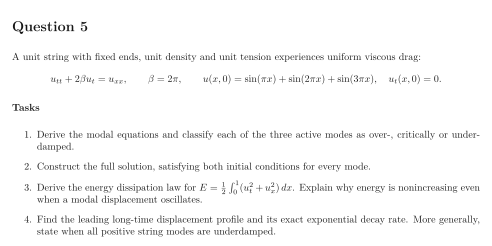
Step 1: Classify the modal roots. With , each coefficient satisfies . For , the discriminant sign is the sign of . Thus mode one is overdamped, mode two is critical, and mode three is underdamped.
Step 2: Impose both initial conditions. The required coefficient functions, all with and , are Then satisfies the damped PDE and both endpoints. The added sinh, linear and sine terms are necessary to make the initial velocities zero.
Step 3: Account for dissipated energy. Differentiate and integrate by parts: The boundary term is zero because fixed ends have zero velocity. Oscillation changes how energy is partitioned; drag still removes energy whenever the velocity is not identically zero.
Step 4: Identify the slow surviving mode. Expanding into two exponentials, its slower coefficient is and its slower decay rate is . The other two modes decay as times bounded or linear factors. Therefore For a nonnegative general drag parameter, mode is underdamped when ; all positive modes are underdamped exactly when . The threshold compares drag with the lowest frequency, not with the highest one.