Question 10
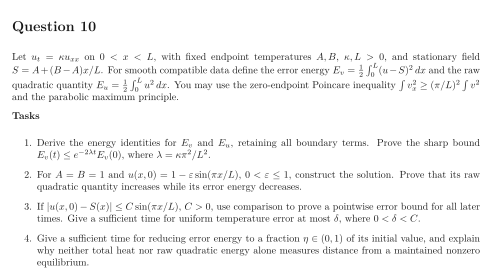
Let on , with fixed endpoint temperatures , , and stationary field . For smooth compatible data define the error energy and the raw quadratic quantity . You may use the zero-endpoint Poincare inequality and the parabolic maximum principle.
Tasks
Derive the energy identities for and , retaining all boundary terms. Prove the sharp bound , where .
For and , , construct the solution. Prove that its raw quadratic quantity increases while its error energy decreases.
If , , use comparison to prove a pointwise error bound for all later times. Give a sufficient time for uniform temperature error at most , where .
Give a sufficient time for reducing error energy to a fraction of its initial value, and explain why neither total heat nor raw quadratic energy alone measures distance from a maintained nonzero equilibrium.
Show solutionHide solution
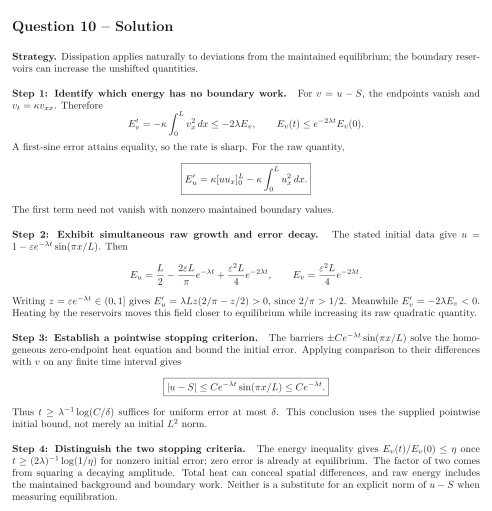
Question 10 – Solution
Strategy. Dissipation applies naturally to deviations from the maintained equilibrium; the boundary reservoirs can increase the unshifted quantities.
Step 1: Identify which energy has no boundary work. For , the endpoints vanish and . Therefore A first-sine error attains equality, so the rate is sharp. For the raw quantity, The first term need not vanish with nonzero maintained boundary values.
Step 2: Exhibit simultaneous raw growth and error decay. The stated initial data give . Then Writing gives , since . Meanwhile . Heating by the reservoirs moves this field closer to equilibrium while increasing its raw quadratic quantity.
Step 3: Establish a pointwise stopping criterion. The barriers solve the homogeneous zero-endpoint heat equation and bound the initial error. Applying comparison to their differences with on any finite time interval gives Thus suffices for uniform error at most . This conclusion uses the supplied pointwise initial bound, not merely an initial norm.
Step 4: Distinguish the two stopping criteria. The energy inequality gives once for nonzero initial error; zero error is already at equilibrium. The factor of two comes from squaring a decaying amplitude. Total heat can conceal spatial differences, and raw energy includes the maintained background and boundary work. Neither is a substitute for an explicit norm of when measuring equilibration.