Question 4
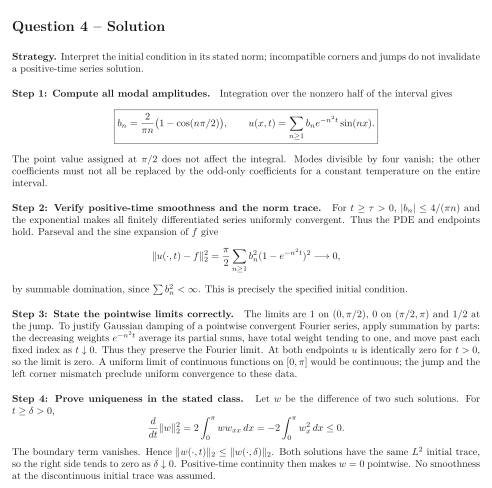
Solve on , , with and initial data in the sense The norm is . You may use sine-series convergence at continuity points and to the average at a jump, and Parseval’s identity.
Tasks
Compute the sine coefficients and construct the heat solution.
Prove that the solution is smooth and solves the PDE for positive time, and that it approaches in as .
State the pointwise limit at the interior jump and at each boundary when boundary values are retained as zero. Explain why convergence cannot be uniform on , even if the endpoints of are defined to be zero.
Prove uniqueness among solutions smooth up to the spatial boundaries for and continuous into at , with these zero endpoint values. Use an energy estimate starting at and then let .
Show solutionHide solution
Question 4 – Solution
Strategy. Interpret the initial condition in its stated norm; incompatible corners and jumps do not invalidate a positive-time series solution.
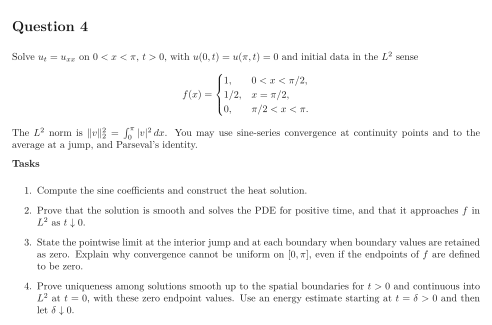
Step 1: Compute all modal amplitudes. Integration over the nonzero half of the interval gives The point value assigned at does not affect the integral. Modes divisible by four vanish; the other coefficients must not all be replaced by the odd-only coefficients for a constant temperature on the entire interval.
Step 2: Verify positive-time smoothness and the norm trace. For , and the exponential makes all finitely differentiated series uniformly convergent. Thus the PDE and endpoints hold. Parseval and the sine expansion of give by summable domination, since . This is precisely the specified initial condition.
Step 3: State the pointwise limits correctly. The limits are on , on and at the jump. To justify Gaussian damping of a pointwise convergent Fourier series, apply summation by parts: the decreasing weights average its partial sums, have total weight tending to one, and move past each fixed index as . Thus they preserve the Fourier limit. At both endpoints is identically zero for , so the limit is zero. A uniform limit of continuous functions on would be continuous; the jump and the left corner mismatch preclude uniform convergence to these data.
Step 4: Prove uniqueness in the stated class. Let be the difference of two such solutions. For , The boundary term vanishes. Hence . Both solutions have the same initial trace, so the right side tends to zero as . Positive-time continuity then makes pointwise. No smoothness at the discontinuous initial trace was assumed.