Question 10
For on , , impose homogeneous Dirichlet endpoints. The separated spatial modes are with eigenvalues , . Consider and the finite-mode initial field Only this finite-mode construction is requested; no arbitrary-data expansion or infinite-series convergence theorem is needed.
Tasks
Derive the time equation for each mode and construct a solution with the given initial field. Verify its PDE and endpoints.
Compare the behavior when with every fixed . Prove that in the latter case converges uniformly to .
Using , compute the squared norm of each modal component and determine the time when the growing component overtakes the decaying component in this norm.
For , , sketch the two positive modal amplitudes and mark their crossing. Explain why finding a decaying separated solution alone does not show that all solutions decay, and state the first-mode threshold in .
Show solutionHide solution
Question 10 – Solution
Strategy. Separation reveals individual growth rates; superposition shows how a small unstable component can dominate a decaying one.
Step 1: Construct and verify the finite sum. For , , so the factor equation is . Consequently Each time derivative has coefficient , matching . Both sine factors vanish at , and their initial coefficients are . Linearity justifies adding these two verified modes.
Step 2: Compare exact cancellation with small contamination. For , the solution decays uniformly because . For fixed , the first mode grows because . Moreover This proves uniform convergence of the normalized shape. The unnormalized solution grows without bound in sup norm, as is also seen at .
Step 3: Compare modal norms exactly. Since , the squared component norms are Their equality is , giving . The growing component is larger for . The crossing time is independent of in the stated range because the difference of modal rates is always three. Orthogonality also gives .
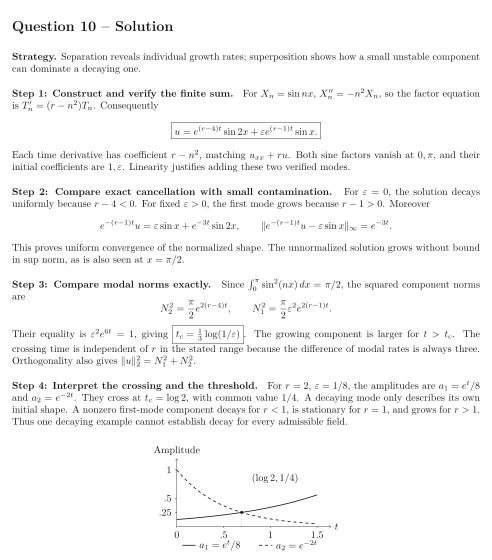
Step 4: Interpret the crossing and the threshold. For , , the amplitudes are and . They cross at , with common value . A decaying mode only describes its own initial shape. A nonzero first-mode component decays for , is stationary for , and grows for . Thus one decaying example cannot establish decay for every admissible field.
See the diagram in the original worksheet below.