Question 1
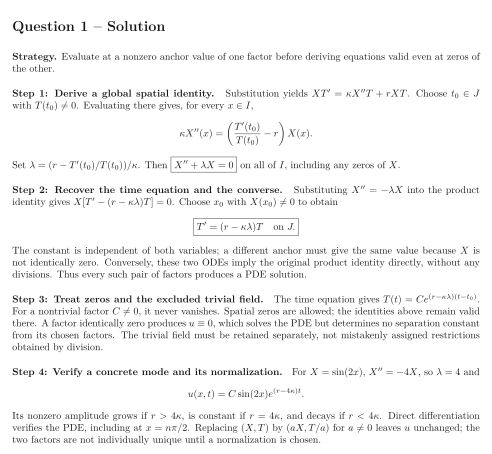
Let be open intervals, , , and consider A separated field is , with and . Assume neither factor is identically zero. Do not assume either factor is nonzero at every point.
Tasks
Substitute the product into the PDE. Choose one time where is nonzero and use it to derive a spatial ODE on all of , without dividing by .
Show that a single real constant gives and everywhere on their respective intervals. Prove the converse as well.
Determine whether a nontrivial can vanish at a time in . Explain why zeros of do not invalidate the separated field and what happens if a factor is identically zero.
Verify when . Find all corresponding time factors, determine the growth threshold in , and explain the harmless freedom to rescale the two factors reciprocally.
Show solutionHide solution
Question 1 – Solution
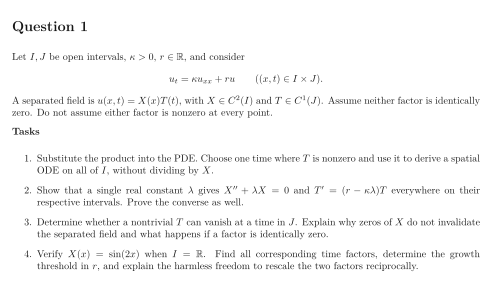
Strategy. Evaluate at a nonzero anchor value of one factor before deriving equations valid even at zeros of the other.
Step 1: Derive a global spatial identity. Substitution yields . Choose with . Evaluating there gives, for every , Set . Then on all of , including any zeros of .
Step 2: Recover the time equation and the converse. Substituting into the product identity gives . Choose with to obtain The constant is independent of both variables; a different anchor must give the same value because is not identically zero. Conversely, these two ODEs imply the original product identity directly, without any divisions. Thus every such pair of factors produces a PDE solution.
Step 3: Treat zeros and the excluded trivial field. The time equation gives . For a nontrivial factor , it never vanishes. Spatial zeros are allowed; the identities above remain valid there. A factor identically zero produces , which solves the PDE but determines no separation constant from its chosen factors. The trivial field must be retained separately, not mistakenly assigned restrictions obtained by division.
Step 4: Verify a concrete mode and its normalization. For , , so and Its nonzero amplitude grows if , is constant if , and decays if . Direct differentiation verifies the PDE, including at . Replacing by for leaves unchanged; the two factors are not individually unique until a normalization is chosen.