Question 9
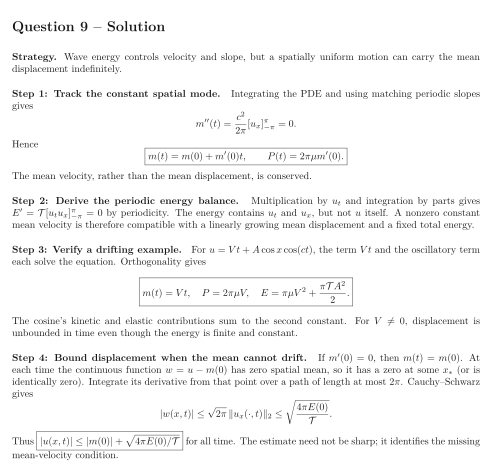
Let a sufficiently smooth displacement be periodic in with period and satisfy , . Define its mean and momentum , with .
Tasks
Derive the evolution of the mean and prove momentum conservation.
Derive conservation of . Does bounded energy force bounded displacement for all time?
Test the explicit family . Compute its mean, momentum and energy exactly and use it to answer the preceding question.
If the mean initial velocity is zero, prove that a uniform displacement bound does follow from energy and the initial mean. You may use continuity, the intermediate value theorem and Cauchy–Schwarz.
Show solutionHide solution
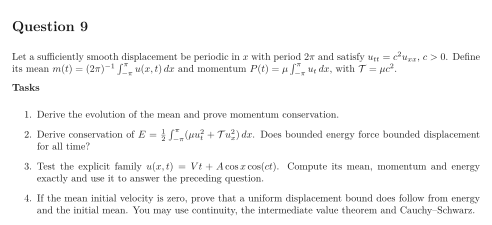
Question 9 – Solution
Strategy. Wave energy controls velocity and slope, but a spatially uniform motion can carry the mean displacement indefinitely.
Step 1: Track the constant spatial mode. Integrating the PDE and using matching periodic slopes gives Hence The mean velocity, rather than the mean displacement, is conserved.
Step 2: Derive the periodic energy balance. Multiplication by and integration by parts gives by periodicity. The energy contains and , but not itself. A nonzero constant mean velocity is therefore compatible with a linearly growing mean displacement and a fixed total energy.
Step 3: Verify a drifting example. For , the term and the oscillatory term each solve the equation. Orthogonality gives The cosine’s kinetic and elastic contributions sum to the second constant. For , displacement is unbounded in time even though the energy is finite and constant.
Step 4: Bound displacement when the mean cannot drift. If , then . At each time the continuous function has zero spatial mean, so it has a zero at some (or is identically zero). Integrate its derivative from that point over a path of length at most . Cauchy–Schwarz gives Thus for all time. The estimate need not be sharp; it identifies the missing mean-velocity condition.