Question 7
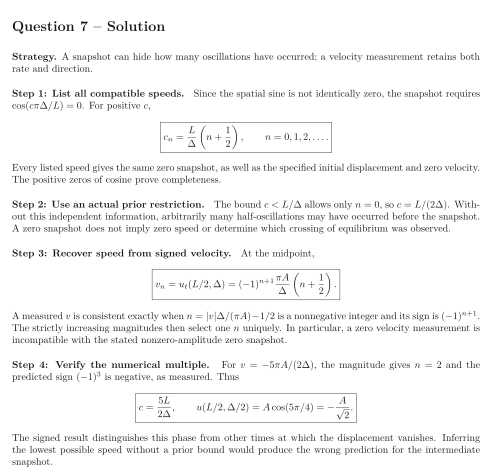
A fixed-end string is known to have displacement with unknown speed . A snapshot at a known time shows for every . Initially the shape and zero velocity are known.
Tasks
Find every positive speed consistent with the zero snapshot and prove the list is complete.
Determine the speed if the independent prior bound is available. Explain why the snapshot alone is insufficient without it.
Derive the midpoint velocity at time for each admissible speed. Give a consistency test for an exact signed velocity measurement and show that it identifies the speed uniquely when consistent.
If the measured velocity is , find and predict the midpoint displacement at time . Verify the signs rather than using only the velocity magnitude.
Show solutionHide solution
Question 7 – Solution
Strategy. A snapshot can hide how many oscillations have occurred; a velocity measurement retains both rate and direction.
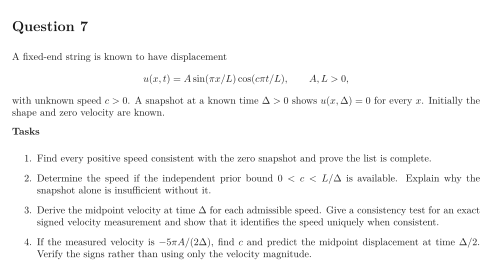
Step 1: List all compatible speeds. Since the spatial sine is not identically zero, the snapshot requires . For positive , Every listed speed gives the same zero snapshot, as well as the specified initial displacement and zero velocity. The positive zeros of cosine prove completeness.
Step 2: Use an actual prior restriction. The bound allows only , so . Without this independent information, arbitrarily many half-oscillations may have occurred before the snapshot. A zero snapshot does not imply zero speed or determine which crossing of equilibrium was observed.
Step 3: Recover speed from signed velocity. At the midpoint, A measured is consistent exactly when is a nonnegative integer and its sign is . The strictly increasing magnitudes then select one uniquely. In particular, a zero velocity measurement is incompatible with the stated nonzero-amplitude zero snapshot.
Step 4: Verify the numerical multiple. For , the magnitude gives and the predicted sign is negative, as measured. Thus The signed result distinguishes this phase from other times at which the displacement vanishes. Inferring the lowest possible speed without a prior bound would produce the wrong prediction for the intermediate snapshot.