Question 1
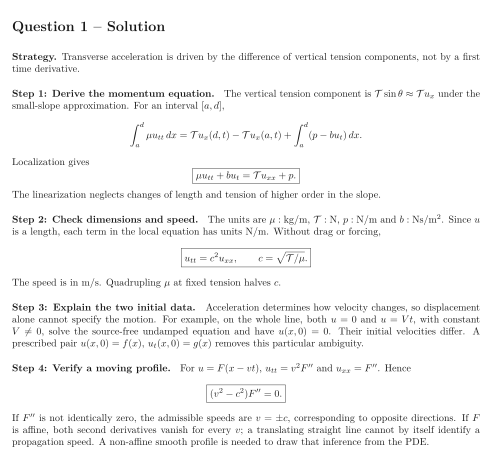
An ideal string has constant tension and mass per unit length . Its small transverse displacement is . Assume , negligible longitudinal motion and bending stiffness, and a transverse applied force per unit length. A linear drag force per unit length is , with .
Tasks
Apply transverse momentum balance on an arbitrary interval and derive the linear wave model, explaining the small-slope approximation.
State the units of and check each term. Identify the undamped wave speed and the effect of quadrupling at fixed tension.
Explain why both initial displacement and initial velocity are needed. Give two different undamped, source-free solutions on the whole line with the same zero initial displacement.
For , test with . Determine when this represents a traveling wave of the string and identify the exceptional profiles that do not determine .
Show solutionHide solution
Question 1 – Solution
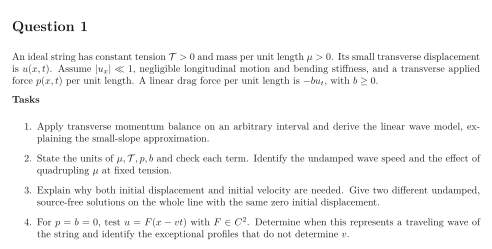
Strategy. Transverse acceleration is driven by the difference of vertical tension components, not by a first time derivative.
Step 1: Derive the momentum equation. The vertical tension component is under the small-slope approximation. For an interval , Localization gives The linearization neglects changes of length and tension of higher order in the slope.
Step 2: Check dimensions and speed. The units are , , and . Since is a length, each term in the local equation has units . Without drag or forcing, The speed is in . Quadrupling at fixed tension halves .
Step 3: Explain the two initial data. Acceleration determines how velocity changes, so displacement alone cannot specify the motion. For example, on the whole line, both and , with constant , solve the source-free undamped equation and have . Their initial velocities differ. A prescribed pair , removes this particular ambiguity.
Step 4: Verify a moving profile. For , and . Hence If is not identically zero, the admissible speeds are , corresponding to opposite directions. If is affine, both second derivatives vanish for every ; a translating straight line cannot by itself identify a propagation speed. A non-affine smooth profile is needed to draw that inference from the PDE.