Question 7
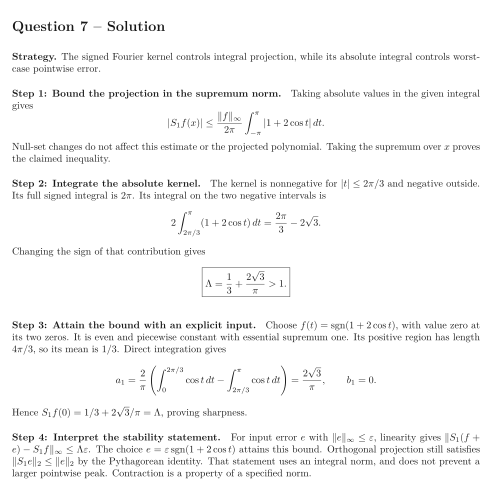
For real bounded piecewise continuous -periodic , its degree-one Fourier projection is Use the essential supremum norm, which ignores changes on sets of measure zero.
Tasks
Prove , where .
Compute exactly, locating every sign change of the kernel.
Construct an admissible with for which equality is attained at . Verify its mean and first cosine coefficient directly.
Use the result to give a sharp worst-case amplification factor for a bounded input error under . Explain why orthogonal projection being a contraction in does not imply contraction in the supremum norm.
Show solutionHide solution
Question 7 – Solution
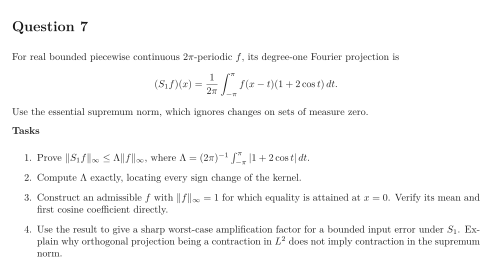
Strategy. The signed Fourier kernel controls integral projection, while its absolute integral controls worst-case pointwise error.
Step 1: Bound the projection in the supremum norm. Taking absolute values in the given integral gives Null-set changes do not affect this estimate or the projected polynomial. Taking the supremum over proves the claimed inequality.
Step 2: Integrate the absolute kernel. The kernel is nonnegative for and negative outside. Its full signed integral is . Its integral on the two negative intervals is Changing the sign of that contribution gives
Step 3: Attain the bound with an explicit input. Choose , with value zero at its two zeros. It is even and piecewise constant with essential supremum one. Its positive region has length , so its mean is . Direct integration gives Hence , proving sharpness.
Step 4: Interpret the stability statement. For input error with , linearity gives . The choice attains this bound. Orthogonal projection still satisfies by the Pythagorean identity. That statement uses an integral norm, and does not prevent a larger pointwise peak. Contraction is a property of a specified norm.