Question 2
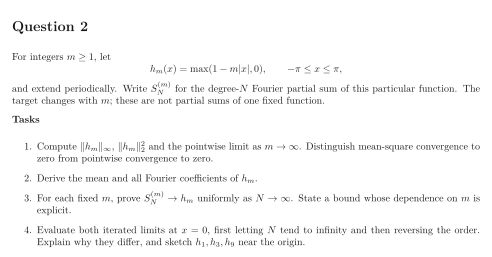
For integers , let and extend periodically. Write for the degree- Fourier partial sum of this particular function. The target changes with ; these are not partial sums of one fixed function.
Tasks
Compute , and the pointwise limit as . Distinguish mean-square convergence to zero from pointwise convergence to zero.
Derive the mean and all Fourier coefficients of .
For each fixed , prove uniformly as . State a bound whose dependence on is explicit.
Evaluate both iterated limits at , first letting tend to infinity and then reversing the order. Explain why they differ, and sketch near the origin.
Show solutionHide solution
Question 2 – Solution
Strategy. A shrinking support can make integral errors small while retaining a fixed peak.
Step 1: Compare the modes of convergence. The peak is always one and direct integration gives The pointwise limit is one at modulo and zero elsewhere. Thus in mean square and almost everywhere, but not at every point and not uniformly. The pointwise limit has a single-point spike in each period.
Step 2: Compute the spectrum. The function is even, so . Its area is , giving mean . Integration over its support gives For each fixed , by . Therefore every fixed coefficient tends to zero as .
Step 3: Keep the target fixed when taking a Fourier limit. For fixed , , so the series converges absolutely and uniformly. The piecewise smooth Fourier theorem identifies its sum with the continuous target . In particular, The factor prevents using this bound uniformly over all targets.
Step 4: Compare the iterated limits. For fixed , the inner -limit at zero is . For fixed , the mean and finitely many coefficients all tend to zero. Thus Fixed-mode convergence does not control the collective contribution of modes whose number grows with . There is no common uniform estimate permitting this interchange.
See the diagram in the original worksheet below.
