Question 9
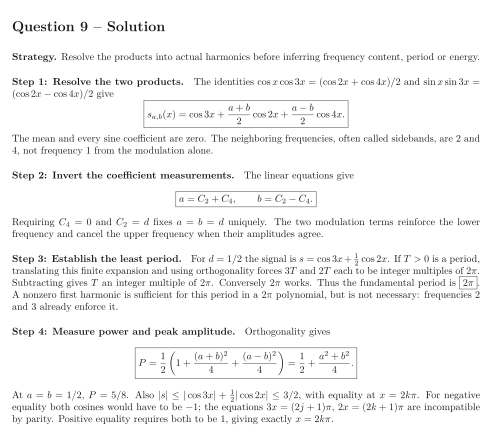
For real , a modulated waveform is Use a Fourier expansion, and define average power as .
Tasks
Derive the complete Fourier spectrum using product identities. Identify the frequencies surrounding the carrier frequency .
Recover from measured cosine coefficients . Determine all choices canceling the frequency- term while leaving a prescribed frequency- coefficient .
For with frequency canceled, find the fundamental period. Prove minimality even though the frequency- coefficient is zero.
Compute the average power for general , then for this special case. Prove a sharp global bound on the special waveform’s absolute value and identify points where equality holds.
Show solutionHide solution
Question 9 – Solution
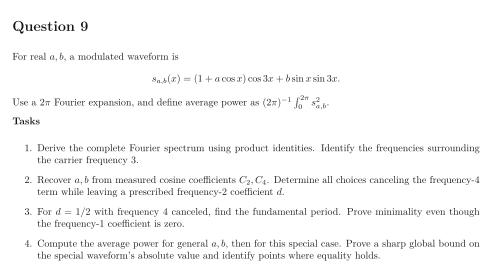
Strategy. Resolve the products into actual harmonics before inferring frequency content, period or energy.
Step 1: Resolve the two products. The identities and give The mean and every sine coefficient are zero. The neighboring frequencies, often called sidebands, are and , not frequency from the modulation alone.
Step 2: Invert the coefficient measurements. The linear equations give Requiring and fixes uniquely. The two modulation terms reinforce the lower frequency and cancel the upper frequency when their amplitudes agree.
Step 3: Establish the least period. For the signal is . If is a period, translating this finite expansion and using orthogonality forces and each to be integer multiples of . Subtracting gives an integer multiple of . Conversely works. Thus the fundamental period is . A nonzero first harmonic is sufficient for this period in a polynomial, but is not necessary: frequencies and already enforce it.
Step 4: Measure power and peak amplitude. Orthogonality gives At , . Also , with equality at . For negative equality both cosines would have to be ; the equations , are incompatible by parity. Positive equality requires both to be , giving exactly .